Showing posts with label art. Show all posts

The River Thames - then and now

Excerpts from an article at The Telegraph about the return of wildlife to a newly-cleaned-up Thames:
It was near this spot in 1878 that more than 600 passengers on the steamship Princess Alice died when the pleasure boat sank in a collision. As they swam towards the safety of the shore, the passengers were overcome by the noxious cocktail of pollution in the water. In 1957, the pollution levels became so bad that the River Thames was declared biologically dead. The amount of oxygen in the water fell so low that no life could survive and the mud reeked of rotten eggs.

Fifty years later, the Thames has become a very different place. It teems with life: 125 species of fish swim beneath its surface while more than 400 species of invertebrates live in the mud, water and river banks. Waterfowl, waders and sea birds feed off the rich pickings in the water while seals, dolphins and even otters are regularly spotted between the river banks where it meanders through London...

Environmental officials now say the Thames is the cleanest it has been in more than 150 years and nearly 400 habitats have now been created to allow wildlife back into the river...

Much of the return of wildlife to the Thames has been due to improvements in water quality. Strict legislation now prevents industry from dumping polluted effluent into the river and its tributeries. Sewage from London and the surrounding area is now treated and then exported.

“Improving the water quality is only half of the battle though,” explains Antonia Scarr, a senior marine advisor with the Environment Agency. “We have had to create the habitats to allow the plants, fish and wildlife to move into...

Even on the smaller rivers and streams that feed into the Thames there is a transformation underway. In Greenwich and Lewisham, extensive work is underway to re-naturalise rivers that for decades have passed unnoticed beneath residents feet... The river Quaggy in Greenwich is one such example. In an area called Sutcliffe Park, the river passed though a culvert hidden beneath a large flat area that was used for football pitches. But in an attempt to restore the wildlife and rich biodiversity that once lived on the river, the Environment Agency opened up the culvert allowed the river to meander through the park.
More at the link. The painting is entitled The Thames by James Jacques Joseph Tissot (1876), via The Mariner's Revenge Song.

p.s. - I've entitled this post "The River Thames..." because I've seen the words used in that order in quite a few different places.  I think I've seen "The River Nile" (perhaps without uppercase r?), but never "The River Mississippi" or "The River Yukon."  Does anyone know what governs a convention like this?

Lungs

The manipulated image is a top-down view of human lungs with the cosmic clouds represented by the blanket over the person's body on the right and the CT table cushion on the left. Fung digitally removed the rest.
Via Physics Buzz.

Were pygmy mammoths present in ancient Egypt?

Excerpts from an interesting piece at Tetrapod Zoology -
...here's the image, as it appears on the beautifully decorated tomb wall of Rekhmire, 'Governor of the Town' of Thebes, and vizier of Egypt during the reigns of Tuthmose III and Amenhotep II (c. 1479 to 1401 BCE) during the XVIII dynasty...

... drew attention to the small, tusked, hairy elephant in the painting, shown as being waist-high to the accompanying people... Its apparent hairiness, convex back and domed head make it look like a juvenile Asian elephant, but then why it is shown with huge tusks?

Inspired by the then-new discovery that a dwarfed population of Woolly mammoths Mammuthus primigenius were still living as recently as 3700 years ago (albeit on Wrangel Island in the Siberian Arctic: Vartanyan et al. (1993), Guthrie (2004)), Rosen (1994) made the tentative suggestion that the elephant shown in Rekhmire's tomb might actually be a dwarf Woolly mammoth. If true, this would have radical implications. It would mean that the ancient Egyptians had a trading link of sorts with far eastern Siberia, and also that mammoths were captured and then transported alive to Africa!..

... there is then a third possibility: this being that Rekhmire's elephant is neither a Siberian mammoth nor a wrongly-scaled 'symbolic' elephant, but perhaps a depiction of one of the pygmy Mediterranean island-dwelling species. Most of the dwarf Mediterranean elephants were Pleistocene animals that were long gone by the time of the Pharoahs, but Masseti (2001) noted that a population of dwarfed elephants seem to have lingered on in isolation on the Greek island of Tilos (located between Rhodes and Kos)...
More at the link, via BoingBoing.

Antislavery button

This daguerreotype with an abolitionist motif may be one of the first political buttons made in America to incorporate a photograph. Believed to be unique, the miniature daguerreotype shows two hands held together, one black, one white resting on a book assumed to be the Bible. The photograph is set into a two-piece gold-washed brass frame with a loop on the reverse for sewing to a garment...

The button was discovered in the early 1980s in a flea market in Massachusetts.
Like the piecework quilts made by women's antislavery societies, this button may have been produced to raise money for the abolitionist cause and sold at one of the popular antislavery fairs organized by women.
From the Metropolitan Museum, via A Polar Bear's Tale.

Cynocephaly in portrayals of Saint Christopher

Dog-headed gods were a well-known component of the Egyptian pantheon.  Some Greeks believed that dog-headed people lived in distant lands, and ancient maps sometimes display such creatures in unexplored regions.

But the Christian Saint Christopher is also depicted in this fashion.
Today the legend of St Christopher helping Christ cross the river has obscured the important canine detail: though the river fording is almost certainly a late addition. In the early Middle Ages the most famous thing about St Christopher was his dog’s head. Indeed, good St Chris is often portrayed thus in medieval manuscript and sculpture...

One possible explanation is that Christopher was the Egyptian god Anubis in disguise. This explanationm suffers from a fatal flaw, however: the two have absolutely nothing in common bar their dog head and some associations – vague in the case of Christopher - with Egypt.

The answer is, instead, almost certainly to be found in an early misunderstanding of some of the grains of fact in the Christopher legend... It appears that Christopher served the Empire in the Cohors III Valeria Marmaritarum. If the name of this unit is to be taken at face value then these soldiers were Marmaritae a tribal people dwelling to the south-west of Egypt, outside the Imperial borders...

But what is interesting is that the first surviving description of this corner of the world, in Herodotus no less, tells us that it was here that the dogheads lived. Early on in the tradition of St Christopher an author perhaps innocently made the connection that was then afterwards taken seriously by hagiological duffers...
From Beachcombing's Bizarre History Blog, where there are additional details.

Battle axe

From the Shang Dynasty (1600 - 1046 B.C.), excavated at Yidu, Shangdong Province, via The Ancient World.  A different axe, from the same era, and also incorporating a human face, is here.  Commentary I've seen suggets that these were more symbolic or ceremonial than functional. 

While quickly searching this subject, I found an even more interesting item (source):
The National Gallery of Art says "In 1989 archaeologists digging at Dayangzhou south of the Yangzi unearthed a tomb filled with intricately patterned bronzes in imaginative shapes as well as a double-sided human mask without precedent in Shang centers in the north."

I'm puzzled at how a "double-sided" object would function as a "mask," but what really intrigued me was the resemblance of this 2000+- year-old object to a more familiar face:

The background behind Mona Lisa

The Telegraph today carried a story about this, then inexplicably embedded a photo which doesn't show the bridge, so I had to search further, and will excerpt instead from a better article at Epoque Travelogue:
Scholars have debated for centuries if the backgrounds of some of Leonardo’s painting were just a figment of his imagination or if they were real landscapes. Professor Carlo Starnazzi, a paleontologist at the University of Florence, and many others here in the Valdarno are convinced that some of those dreamy landscapes are in fact inspired by this region.

Take the most famous of the great Master’s paintings, the Mona Lisa, which was painted between 1503 and 1507, that is after Leonardo’s activity in the Arezzo region. The landscape in the background is illustrated by an odd cliffy land that resembles the Calanchi very much. Moreover, on the center-right end of the painting, more or less at the height of Mona Lisa’s shoulder, one can distinguish an arched bridge.

For many experts, this bridge is none other than the Buriano bridge Ponte Buriano, built in approximately 1277 and a marvel of engineering of its time. The Buriano bridge, still open to traffic to this day, consists of seven distinctive arches and lies 6 km from the city of Arezzo: it is very reasonable to argue that Leonardo took careful notice of it while studying the area and placed it so gracefully in his masterpiece.
The same bridge appears in the Madonna of the Yarnwinder (1502).  For those photos, and other discussion re the mountainous landscape, see the primary link.

Mona Lisa source.

The rape and suicide of Lucretia

The Suicide of Lucretia. Lucas Cranach the Elder (via Réunion des musées nationaux)
Lucretia is a legendary figure in the history of the Roman Republic... her rape by the king's son and consequent suicide were the immediate cause of the revolution that overthrew the monarchy and established the Roman Republic. The incident kindled the flames of dissatisfaction over the tyrannical methods of the last king of Rome, Lucius Tarquinius Superbus. As a result, the prominent families instituted a republic, drove the extensive Tarquin family from Rome, and successfully defended the republic against attempted Etruscan and Latin intervention...

The next day Lucretia dressed in black, went to her father's house in Rome and cast herself down in the suppliant's position (embracing the knees), weeping. Asked to explain herself she insisted on first summoning witnesses and after disclosing the rape called on him and them for vengeance, a plea that could not be ignored, as she was speaking to the chief magistrate of Rome. While they were debating she drew a concealed dagger and stabbed herself in the heart. She died in her father's arms, with the women present keening and lamenting. "This dreadful scene struck the Romans who were present with so much horror and compassion that they all cried out with one voice that they would rather die a thousand deaths in defence of their liberty than suffer such outrages to be committed by the tyrants."

The story of Lucretia was a popular moral tale in the later Middle Ages. The story has been recounted in Geoffrey Chaucer's The Legend of Good Women, John Gower's Confessio Amantis (Book VII), and John Lydgate's Fall of Princes. Lucrece is also featured in William Shakespeare's 1594 long poem The Rape of Lucrece; he also mentioned her in Titus Andronicus, As You Like It, and Twelfth Night...
Image via A London Salamagundi.

Monstrance axe

A ritual axe from Berlin's Ethnologisches Museum, which I found posted at A London Salamagundi.  Made in New Caledonia (?when), of hair, jadeite, shell, stone, and textile (source).

I found more explanation re the name of the object at Tribal Art:
Admiral Bruny d’Entrecasteaux and his sailors were the first in the West to encounter an unusual object... in what we now know as New Caledonia from April 17–May 3, 1793. His stay was longer than Captain Cook’s in 1774, and he was able to observe objects other than the spears and clubs that his illustrious predecessor had seen. While there, he was presented with an object that he had difficulty describing. He thought that it slightly resembled the monstrance used in Catholic ritual in connection with the Host, and to this day the term remains part of the French name for the object, which is called hache ostensoir, or “monstrance axe.” 
Additional information at Tribal Art and at the Ngilong Art Gallery.

Bookshelf

Found at Distraction, via Bookshelf Porn.

This pulp art painting sold for $143,000

From a recent sale at Heritage Auction Galleries:

HUGH JOSEPH WARD (American, 1909-1945)
The Evil Flame, Spicy Mystery Stories pulp cover, August 1936
Oil on canvas
28.5 x 19.5 in.
Signed lower right

This is not only the most important Ward pulp cover we've ever offered -- it's one of the absolute best pulp covers that exists, by any artist. Iconic is the adjective that best sums up the entire over-the-top approach that pulps are now celebrated for. As pulp art historian Robert Lesser so vividly recounted about the Ward approach in his book, Pulp Art, Gramercy Books, 1997, "One day in April 1942 Mayor la Guardia spied an unusual Spicy mystery on the newsstand and exploded in instant rage. He ruled on the spot: 'No more Spicy pulps in this city.' H. J. Ward was the cover artist and it was one of his most daring: sexual tension, violence in action, a beautiful woman, all painted with aggressive brushwork to create a cover that couldn't fail to catch the eye."

Via Accidental Mysteries.

Women with monkeys as prostitutes

We'll begin with the photograph above (credit here, via BoingBoing 2006):
"...the community of Beloit, Wisconsin came together on the banks of the Rock River to recreate George Seurat’s “Sunday Afternoon on the Island of LaGrande Jatte."
They are performing a tableaux vivant to reproduce the famous pointillist painting shown here:
One difference between the photograph and the painting is that in the photograph, the woman in the foreground does not have a monkey at her feet.  This may have reflected unavailability of one in Beloit, Wisconsin - or it may have been intentional, since the monkey symbolically represents that the woman may be a prostitute:
Furthermore, the inclusion of symbols, most obviously a monkey on a leash and a woman fishing, is indicative of the painting’s satirical nature. In nineteenth century slang, ‘singesse’ (female monkey in French) meant prostitute. The wordplay of ‘pêche’ (fishing) and ‘péché’ (sin) was a pun often made in French cartoons with reference to prostitution.  Such symbols speak to the ability of “the proletarian woman [to] become superficially bourgeois through prostitution.”  Through this subtle imagery, Seurat adds another dimension to the comparison of the proletariat and the bourgeoisie, noting the superficiality and immorality within high class society.
That was all new to me, so I searched the web for pictures of women with monkeys, and after discarding those with Dian Fossey, Jane Goodall, Fay Wray, and Jessica Lange, I found this one by Aubrey Beardsley at La Muse Verte:
The Lady and the Monkey. c. 1897
and this one by Picasso:
- both of which presumably incorporate the monkey with woman = prostitute symbolism, as may this this depiction mocking an early American suffragette:
- both found at Infinite Thought, where there are other photos of women with monkeys.

I got started on this topic because of a Reddit thread last month, where the best comment comparing the Beloit photograph and the Seurat painting came from UserNumber42:
"Oddly enough, both were created with very small dots, one just has better resolution than the other."
And finally, since I won't have another chance to blog tableaux vivant again, I'll close with this old but quite remarkable music video by Hold Your Horses:

The art works recreated in the video are listed at Blog of an Art Admirer and History Lover.

The Oracle of Delphi

Hon. John Collier : Priestess of Delphi (1891)
In the painting, “Priestess of Delphi” by The Honorable John Collier, a priestess - the Pythia - is depicted in a trance state, seated over a fissure in the rock through which vapors rise from the underground stream. In her left hand is a sprig of laurel - in Greek mythology, Apollo’s sacred tree - and in the other hand a bowl meant to hold some of the water from the stream containing the gases.
Image via marinni and Uncertain Times.  More information from Wikipedia:
Apollo spoke through his oracle: the sibyl or priestess of the oracle at Delphi was known as the Pythia; she had to be an older woman of blameless life chosen from among the peasants of the area. She sat on a tripod seat over an opening in the earth. When Apollo slew Python, its body fell into this fissure, according to legend, and fumes arose from its decomposing body. Intoxicated by the vapors, the sibyl would fall into a trance, allowing Apollo to possess her spirit. In this state she prophesied. It has been postulated that a gas high in ethylene, known to produce violent trances, came out of this opening, though this theory remains debatable.  While in a trance the Pythia "raved" – probably a form of ecstatic speech – and her ravings were "translated" by the priests of the temple into elegant hexameters. People consulted the Delphic oracle on everything from important matters of public policy to personal affairs. The oracle could not be consulted during the winter months, for this was traditionally the time when Apollo would live among the Hyperboreans. Dionysus would inhabit the temple during his absence.

Antique phalliform bottle

Title :  Bouteille en forme de phallus
Description :  16e siècle (?) Collection "Erotica"

Frank Netter, artist

Anyone who has taken classes in the medical professions is familiar with the work of this man.
Medical illustrations are typically found in textbooks. But a new museum exhibition in New Jersey showcases these illustrations as art.

The exhibition, at the Morris Museum in Morristown, highlights the work of Dr. Frank H. Netter, whose career as a medical illustrator spanned half a century. Dr. Netter, who died in 1991 at the age of 85, produced more than 4,000 detailed images of human anatomy and physiology...

For the Golden Gate Exposition in 1939, Dr. Netter created a 7-foot, three-dimensional "transparent woman," that depicted the physical and sexual development of a woman."We knew it was a successful figure because every 15 minutes, someone viewing the presentation fainted," Dr. Netter said.
A preview gallery of the exhibit is posted at the New York Times.  Photo credit NetterImages.com.

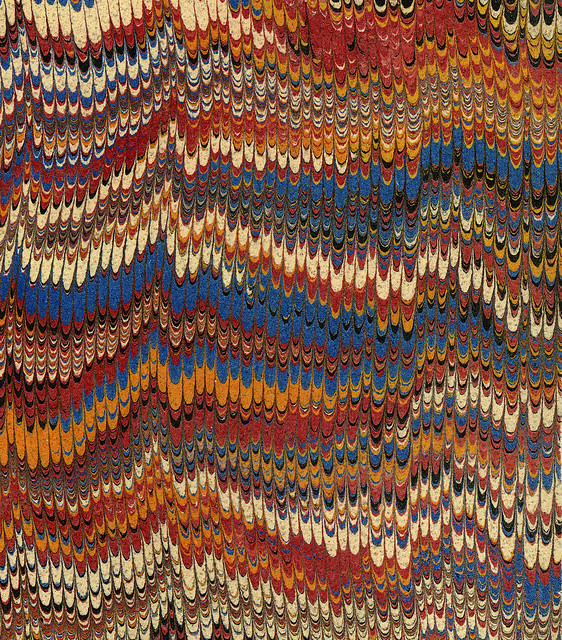
Marbled paper

BibliOdyssey has a nice essay with a dozen photos of examples of marbled paper.  My only memory of such paper is from the interior of book covers, but there were other uses:
They served, for example, as wall coverings; as linings for the interiors of trunks, boxes, wallets, musical instrument cases and other containers; for covering boxes and other receptacles; as ornamentation in the panels of cabinets, furniture, and even harpsichords; as wrappings for toys, drug powders, and other consumer goods; for enclosing blank books used for writing, and for other stationary purposes; and as shelf papers for lining cupboards and cabinets and for many home-decorating purposes.
(From the introduction to: 'Marbled Paper: Its History, Techniques, and Patterns' 1990 by Richard J Wolfe, widely regarded as the leading authority on marbling.)

The history of marbling is fairly obscure. It is thought that the decoration first appeared in Japan by at least the early 12th century, from a process known (still) as Suminagashi ('sumi' means ink and 'nagashi' means floating, thus 'a pattern formed by floating ink'). The craft may have arisen in China independently or was imported from Japan very early on in the piece. Certainly, the inference in all the references is that a marbling technique was first practised in Japan.

Perhaps a century later, marbling appeared in, or near, Afghanistan, becoming an artform of the Persian and Ottoman worlds, centred in Turkey. Again, the marbling process may have been imported from the far East via the Silk Road trade route or it arose independently. The distinct Turkish marbling technique is known as Ebru and even the origin of that word is contentious, connoting either cloud art or water surface in Farsi or a related regional dialect.

The Suminagashi and Ebru forms of marbling are simplistic and rudimentary in comparison to the diverse and technically precise art that emerged subsequently in Europe. In this case it is known that the technique was transplanted from Turkey to France, Italy and Germany in the 15th and 16th centuries, where a much larger body of craftsmen developed the technique over a few centuries.
For a video showing how the marbling effect is created nowadays, see this post.

Treehopper sculpture

This summer I posted a photo of a treehopper with an immense pronotum, but that one is ordinary compared to the one in the image above.  It's a sculpture by Alfred Keller:
Keller was trained as a kunstschmied, an ‘art blacksmith’. From 1930 until his early death he was employed by the Berlin Museum für Naturkunde (Museum of Natural History), painstakingly labouring over his recreations of insects and their larvae. Each took a year to complete. Keller worked first in plasticine, from which he cast a model in plaster. This plaster reference model he then recast in papier maché. Some details he added, cast in wax, with wings and bristles in celluloid and galalith (an early plastic material used in jewellery). Finally he coloured the surfaces, sometimes with additional gilding. The levels of patience and manual control Keller exercised were incredible. His fly, for example, boasts 2,653 bristles.
For a discussion of the excrescences on the critter's head, see the discussion at Why Evolution is True, via BoingBoing.

"Landscape with the corpse of a horse"

Who wouldn't want this subject matter gracing a prominent place in their home?  An oil painting by Gustave Courbet (~1855-60), currently in the St. Petersburg Hermitage.

Found at petrus.agricola's Flickr photostream, via Uncertain Times.

Aurignacian art

"A woman views what is claimed to be the oldest known art work at the Neanderthal Museum in Mettmann, Germany. The ivory carving of a mammoth, 35,000 years old, was found in southern Germany."
Discoveries in this area were reported in Der Spiegel in 2007:
Archaeologists at the University of Tübingen have recovered the first entirely intact woolly mammoth figurine from the Swabian Jura, a plateau in the state of Baden-Württemberg, thought to have been made by the first modern humans some 35,000 years ago. It is believed to be the oldest ivory carving ever found...

In total, five mammoth-ivory figurines from the Ice Age were newly discovered at the site of the Vogelherd Cave in southwestern Germany... The geological context of the discoveries and radiocarbon dating indicate that the figurines belong to the Aurignacian culture, which refers to an area of southern France and is associated with the arrival of the first modern humans in Europe.
Additional photos at the link, and further discussion at John Hawks' Weblog.

Via Found Here.  Photo: Martin Meissner/AP