This is all quite legal, of course, as long as the label specifies "fruit-flavored clusters," or something equivalent. But it's still intentionally deceptive, and a scummy corporate behavior, IMHO.The nonprofit Consumer Wellness Center reported that its investigation found "blueberries" that were nothing more than a concoction of sugar, corn syrup, starch, hydrogenated oil, artificial flavors and artificial food dye blue No. 2 and red No. 40.
The offenders are well-known manufacturers such as Kellogg's, Betty Crocker and General Mills, and the fakes were found in bagels, cereals, breads and muffins. Some products contain real blueberries mixed with fakes. For example, the blueberry bagels sold at Target contain some real berries but the "blueberry bits" listed in the ingredients aren't real blueberries...
Kellogg's Frosted Mini Wheats Blueberry Muffin variety has no blueberries but does have "blueberry flavored crunchies" made from the sugar-and-dye concoction mentioned above. Total Blueberry Pomegranate cereal, from General Mills, contains no blueberries and no pomegranates...
Showing posts with label food. Show all posts
Showing posts with label food. Show all posts
Fake fruit in your cereal?

Bacon candle

French toast meets a waffle iron

Saffron

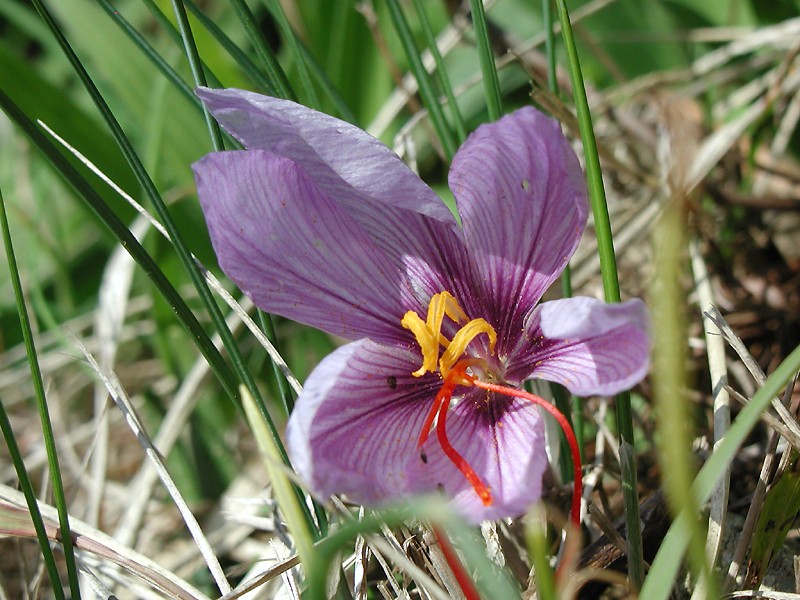
Costing US$4,000 per kilogram, this pricey ingredient is used in medicine and South Asian cuisine... The biggest long-term challenge is the adulteration of saffron. Cheap, fake brands of saffron sell briskly on the streets of Srinagar. And it is virtually impossible for a non-professional to distinguish between a fake and the real one. This fact has dented saffron's image, and resulted in a drop in prices.The word "saffron" (and Italian zafferano and Spanish azafrán) come from the Latin word safranum, probably ultimately from Persian and Arabic precursors. The spice itself is extracted from the saffron crocus (C. sativus). [The photo above is of non-saffron Wisconsin crocuses]. The following tidbits are excerpted from Wikipedia:
Saffron-based pigments have been found in 50,000 year-old depictions of prehistoric places in northwest Iran. Later, the Sumerians used wild-growing saffron in their remedies and magical potions. Saffron was an article of long-distance trade before the Minoan palace culture's 2nd millennium BC peak... During his Asian campaigns, Alexander the Great used Persian saffron in his infusions, rice, and baths as a curative for battle wounds. Alexander's troops imitated the practice from the Persians and brought saffron-bathing to Greece...Here's a photo a real saffron crocus (note the red "thread").
During the 14th century Black Death, demand for saffron-based medicine skyrocketed, and much saffron had to be imported via Venetian and Genoan ships from southern and Mediterranean lands... Cultivation and trade then spread to Nuremberg... Soon after, saffron cultivation spread throughout England, especially Norfolk and Suffolk... By 1730, the Pennsylvania Dutch were cultivating saffron throughout eastern Pennsylvania. Spanish colonies in the Caribbean bought large amounts of this new American saffron, and high demand ensured that saffron's list price on the Philadelphia commodities exchange was set equal to that of gold...
Saffron is widely used in Iranian (Persian), Arab, Central Asian, European, Pakistani, Indian, Turkish, and Cornish cuisines. Confectionaries and liquors also often include saffron. Common saffron substitutes include safflower, annatto, and turmeric...
A pound (454 grams) of dry saffron requires 50,000–75,000 flowers, the equivalent of a football field's area of cultivation... Forty hours of labour are needed to pick 150,000 flowers... The price in Canada recently rose to CAN$18,000 per kilogram. In Western countries, the average retail price is $1,000/£500/€700 per pound (US$2,200/£1,100/€1,550 per kilogram)...
Saffron is graded via laboratory measurement of crocin (colour), picrocrocin (taste), and safranal (fragrance) content. Determination of non-stigma content ("floral waste content") and other extraneous matter such as inorganic material ("ash") are also key... Adulteration was first documented in Europe's Middle Ages, when those found selling adulterated saffron were executed under the Safranschou code. Typical methods include mixing in extraneous substances like beets, pomegranate fibers, red-dyed silk fibers, or the saffron crocus's tasteless and odorless yellow stamens. Other methods included dousing saffron fibers with viscid substances like honey or vegetable oil. However, powdered saffron is more prone to adulteration, with turmeric, paprika, and other powders used as diluting fillers. Adulteration can also consist of selling mislabeled mixes of different saffron grades. Thus, in India, high-grade Kashmiri saffron is often sold and mixed with cheaper Iranian imports; these mixes are then marketed as pure Kashmiri saffron, a development that has cost Kashmiri growers much of their income...
The etymology of "nachos"
While browsing the OED website last night (see post below), I found this interesting article about how a library researcher tracked down the initial usage and etymology of the word "nachos."
In September 1988 a slip of paper (the usual 4 x 6) for this word came from one of the editors, stating that the earliest quotation in the OED files was from a 1978 issue of the Tucson (Arizona) Magazine... Could I antedate? Added was a postscript asking if I could find its etymology. WNCD had suggested it might be 'fr. Sp. "nacho" flat-nosed'. Could I confirm this?...Armed with that information, you should be able to corral a free Dos Equis next time you go out for a Mexican dinner with friends.
I called several Texan friends in Washington that evening and each of them wanted to tell me all about nachos but none knew how the name had been derived. After three phone calls (and three different recipes for perfect nachos) I gave up on nachos that evening.
As I walked down the long corridor leading back to the library's central core, I heard a voice softly calling my name. There was a young woman I recognized as a staff member of the Hispanic Division. She had overheard our discussion of nacho in the reading room but had been reluctant to interrupt us. She told me she had been born and raised in Mexico and there nacho has only one common usage: it is the word used as a diminutive for a little boy who had been baptized Ignacio. His family and friends call him Nacho. She thought I should know this. What a wonderful bit of information!.. Now I was convinced there was a real Nacho somewhere who had dreamed up a combination of tortilla pieces with melted cheese and jalapeño peppers...
Several 1965+ quotations surfaced, and eventually I found A Taste of Texas, edited by Jane Trahey in 1949 with a perfect nachos quote on page 27:Pedro left. Sometime later he returned carrying a large dish of Nachos Especiales. 'These Nachos,' said Pedro, 'will help El Capitan—he will soon forget his troubles for nachos make one romantic.'And to add to the satisfaction, we have recently, with the help of the Rector and one of the parishioners of the Church of the Redeemer, Eagle Pass, Texas, been able to verify a quotation from that elusive 1954 St Anne's Cookbook which confirms the existence of Ignacio 'Nacho' Anaya, gives the Victory Club as the place in which he invented his 'nacho specials', and provides his own original recipe...
How to prepare muskrat for dinner
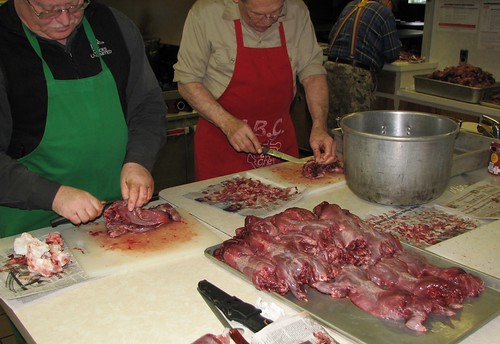
Muskrats are referred to as "rats" in a general sense because they are medium-sized rodents with an adaptable lifestyle and an omnivorous diet. They are not, however, so-called "true rats", that is, members of the genus Rattus. The muskrat's name comes from the two scent glands which are found near its tail; they give off a strong "musky" odor which the muskrat uses to mark its territory...And it is from the Monroe, Michigan area that the always-interesting nature blog Naturespeak originates, and that is where I found these culinary tips:
Muskrats can swim under water for 12 to 17 minutes. Their bodies... are less sensitive to the buildup of carbon dioxide... in swimming the tail is their main means of propulsion...
They feed on cattails and other aquatic vegetation. They do not store food for the winter, but sometimes eat the insides of their lodges... Muskrats provide an important food resource for many other animals... Caribou and elk sometimes feed on the vegetation which makes up muskrat lodges during the winter when other food is scarce for them...
Muskrats have sometimes been a food resource for humans... In the Roman Catholic Archdiocese of Detroit, there is a longstanding dispensation allowing Catholics to consume muskrat on Ash Wednesday, and the Fridays of Lent (when the eating of meat, except for fish, is prohibited). Because the muskrat lives in water, it is considered equivalent to fish. Lenten dinners of muskrat are therefore traditional in parts of Michigan.
The ‘rats arrived at the club naked, hollow, and footless but with their heads intact (as a hold-over of another tradition in which the heads were also considered delicacies). By the time they reached our cleaning table, however, the heads too were gone and all that was left to do was the fat nit-picking...There is more information at the link - Part 1 and Part 2. Bon appetit!
There were obvious fat deposits on the flanks, back, and inner backbone that were there to scrape off. These were easily removed. Hidden deposits, tucked under the shoulder blades and deep inside the thigh muscles, were much more elusive...
The whole reason for cleaning muskrats is to prepare them for eating, although they are animals that really don’t need “cleaning” per se. They are among the cleanest of beasts – eating a crisp vegetarian diet and obsessively washing themselves whenever and wherever possible...As you walked down the line, your plate was piled high with one whole ‘rat per serving. The meats were served from a large cooker and the carcasses appeared to be swimming in a pool of creamed corn. Ample doses of the corn stew were then poured upon the beast and a hefty plop of mashed potatoes was placed next to it. Just for good measure, more corn was dumped upon the potatoes. This is the time-honored way to serve muskrat around these parts...
Separate platters, placed in the middle of the table for throwing bones, quickly amassed piles of shins, scapulas, fibias, tibias, and rib bones – lots of rib bones- as the meal progressed.

"TV dinners" of the 1960s

Drinks containing... mayonnaise
- Greasy Mexican (Shooter)
- Mayonnaise, Tequila
- Smoker's Cough (Shooter)
- Jagermeister, Mayonnaise
- Swass Factory (Cocktail)
- Firewater, Jim Beam Bourbon Whiskey, Mayonnaise, Tabasco Sauce, Tonic Water
- The Tapeworm (Shooter)
- Black Pepper, Mayonnaise, Tabasco Sauce, Vodka
Large corporations masquerade as small businesses
A column at Counterpunch cites the example of California's wine industry:
These activities are capital-intensive. For those with enough pre-existing wealth to shoulder the heavy up-front costs, the profits can be enormous... ownership of the industry has grown increasingly concentrated. Most vineyard acreage in the region is ruled by a small collection of massive multi-national corporate conglomerates, which typically boast annual revenues greater than a billion dollars.More at the link, and more articles coming on this topic.
To hear the patriarchs of the wine industry tell it, by contrast, the typical area wine-making operation is a “bucolic,” family-owned business...
In reality, while there remain some area vineyards that possibly fit the Wine Commission web site characterization, a huge portion of Mendo's vineyard acreage is owned by corporate conglomerates that belong to the billion-dollar-a-year set. Most of the other wine-grape plantations are remotely controlled by decidedly non-local corporations with revenues of at least $50 million a year...
Over the years, wine industry robber-baron Jess Jackson has gone to perhaps the most absurd lengths of all to garb his company in a rustic wine-maker mystique. The company no longer refers to itself as Kendall-Jackson, but rather as Jackson Family Wines... “Little Guy” Jackson landed in the upper half of Fortune magazine's 2003 ranking of the world's 500 richest people, with personal wealth of $1.8 billion...
More to the point, the profits generated by local vineyards accrue almost entirely to the wine industry big boys. Just seven global wine conglomerates purchase the vast majority of wine grapes grown in the United States. The majority of these are grown in California. These companies produce 82 percent of all wine sold throughout the country. The majority of these enormous companies are integrated with other units of Big Alcohol; namely, spirits and beer.
The upshot? Regardless of who runs the actual grape production side, it's the large multi-nationals that ultimately reap the benefits of the local wine-growing economy – just as with virtually every other sector of America's agribusiness enterprise – at the expense of just about everyone and everything else...
As Wendell Berry has written regarding the corporate agribusiness model in general, “To put the bounty and health of our land, our only commonwealth, into the hands of people who do not live on it and share its fate will always be an error. Whatever determines the fortune of the land determines also the fortune of the people. If history has taught us nothing else, it has taught us that.”
"Morbid" Italian treats

To us the word "morbid" has rather negative connotations: "Of the nature of, or indicative of, disease." The second meaning is "of mental conditions, unwholesome, sickly." The etymology (according to the OED) is from the Latin morbid-us = disease, with comparisons offered to French morbide and Italian and Spanish morbido.
So why are the Italian foods designated "morbido" ? Google offers an Italian/English translation to "soft" - which seems to fit the desserts depicted. That's the answer, but how are the words connected? By what etymological journey did a word meaning disease come to designate softness? As a reflection of the putrefactions of advanced disease?
Perhaps related to this question, I see a third meaning in the OED: in the world of painting, morbido refers to "flesh-tints" ("painted with morbidezza" - after It. morbido). This citation from 1686 is offered: "There is a thing which the Italians call Morbidezza: The meaning of which word, is to Express the Softness, and tender Liveliness of Flesh and Blood."
Sherry
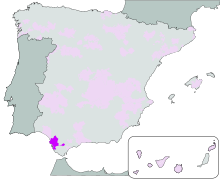
Sherry is a fortified wine made from white grapes that are grown near the town of Jerez, Spain. In Spanish, it is called vino de Jerez.And I found this while researching the word: the hit song "Sherry" (Four Seasons, 1962) was originally titled "Jackie Baby" in honor [?] of then-first-lady Jacqueline Kennedy.
The word "sherry" is an anglicization of Jerez. In earlier times, sherry was known as sack (from the Spanish saca, meaning "a removal from the solera"). "Sherry" is a protected designation of origin; therefore, all wine labeled as "sherry" must legally come from the Sherry Triangle... (However the name 'sherry' is used as a semi-generic in the United States where it must be labeled with a region of origin such as American sherry or California sherry.)
Jerez has been a center of viniculture since wine-making was introduced to Spain by the Phoenicians in 1100 BC. The practice was carried on by the Romans when they took control of Iberia around 200 BC. The Moors conquered the region in AD 711 and introduced distillation, which led to the development of brandy and fortified wine.
During the Moorish period, the town was called Sherish (a transliteration of the Arabic شريش), from which both Sherry and Jerez are derived. Wines similar in style to sherry have traditionally been made in the city of Shiraz in midsouthern Iran, but it is thought unlikely that the name derives from there.
Though the drinking of alcohol is prohibited in the Qur'an, wine production continued through five centuries of Islamic rule. In 966 the Caliph of Cordoba Al-Hakam II ordered the destruction of the vineyards, but the inhabitants of Jerez appealed on the grounds that the vineyards also produced raisins to feed the empire's soldiers, and the Caliph spared two-thirds of the vineyards.
Lithium in 7-Up
Everyone knows that Coca-Cola was originally formulated to contain cocaine. I didn't know that 7-Up contained lithium.
... lithium was widely marketed as one of a number of patent medicine products popular in the late-19th and early-20th centuries, and was the medicinal ingredient of a refreshment beverage, 7 Up. Charles Leiper Grigg, who launched his St. Louis-based company The Howdy Corporation in 1920, invented a formula for a lemon-lime soft drink in 1929. The product, originally named "Bib-Label Lithiated Lemon-Lime Soda", was launched two weeks before the Wall Street Crash of 1929. It contained the mood stabiliser lithium citrate and was one of a number of patent medicine products popular in the late-19th and early-20th centuries. The beverage was marketed specifically as a hangover cure. Its name was soon changed to 7 Up.More about 7-Up and the history of its name at Snopes.
Throwing dough around
"This is an Indian dish named 'Parotta'. The man makes it flat and throws it to the cook who will cook it in a hot and flat iron top."
Via 22 Words.
Cannery worker filling tuna cans, ~1930

From the Flickr photostream of the University of Washington Libraries Digital Collections.
The role of salivary amylase
It does more than just pre-digest your food, as a WSJ article explains:
While taste sensations are fairly well understood, scientists are just beginning to unravel the mystery of food texture.And this interesting tidbit for those of you with small children -
Now, researchers at the Monell Chemical Senses Center in Philadelphia have found that an enzyme in saliva called amylase, which breaks down starch into liquid, could play a key role in determining the appeal of various textures of food. A new genetic study shows that people produce strikingly different amounts of amylase, and that the more of the enzyme people have in their mouth the faster they can liquefy starchy foods.
Scientists think this finding could help explain why people experience foods as creamy or slimy, sticky or watery, and that this perception could affect our preference for foods...
The role of amylase and the rate of starch breakdown also has implications for diabetes. People who digest starch quickly could be more likely to have larger spikes in blood-sugar levels and thus a need for the body to generate more insulin. This continued demand on the body might lead these people to become insulin resistant or even diabetic...
Amylase and other enzymes in saliva could also help explain food-texture preferences that are known to vary with age...
...adults with a gene that makes bitter tastes more intense consume fewer vegetables containing bitter compounds, such as kale or spinach.
But that genetic preference can be changed by repeatedly exposing the individual to the taste or by masking the bitterness, even at an early age, she has found. In a preliminary study with preschoolers, Dr. Duffy's group added a sweet taste to balance out the bitterness of certain vegetables—less than half a teaspoon of sugar to a cup of broccoli or asparagus, for example, during cooking—and found that the children were more accepting of the greens. Even when the sweetness was removed, the children still liked the vegetables more than before because they had developed a positive association with them
Obesity in the U.K.
As reported by The Independent:
With obesity rates skyrocketing, British retailer High and Mighty is now meeting demand by stocking its stores with the largest clothing size ever made: the XXXXL. Expanded shirts fit men with 64-inch (163 cm) chests, pants fit 60-inch (152 cm) waists...
According to a recent survey by the World Health Organization, 61 percent of the population in the UK is overweight, compared to almost 67 percent in the United States. Twenty percent of British men now have a waist size larger than 38 inches (97 cm), and a chest size larger than 44 inches (112 cm), reports Telegraph...
Other UK retailers are targeting teens and children needing expanded garments... this summer Marks & Spencer started selling school uniforms with 41-inch (104 cm) waists. In the US, major retailers sell plus-size clothing alongside normal sizes, and specialty retailers such as Torrid, which ships internationally, offer trendier options for obese teenagers...
The preparation of "pulled tea" (Teh tarik)
This man demonstrates a technique used in Malaysia.
The mixture is poured back and forth repeatedly between two vessels from a height, giving it a thick frothy top. This process cools the tea to drinking temperatures, and helps to thoroughly mix the tea with the condensed milk. It is also done to give the tea a better flavour...Found at Anything and Everything, via Neatorama.

Musing about corn

When I was growing up in Minnesota, a cornfield was the very essence of rural America and a defining factor for the family farm (I understand things would be different in cotton country or wheat country). Here's a great map of "land cover" in the Upper Midwest, from GIS and Science, showing the "corn belt" of the U.S. in yellow:


In these past ten years, I've thought I detected a change; the cornfields seemed to be increasing. At the micro level, I've noticed it where I hike; the farmers have been swinging their cultivators a bit wider each year, trying to get in a extra row or two of planting. On the macro level, I seem to see corn where there wasn't corn before. A search this morning yielded this graph:
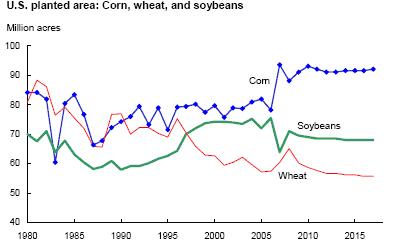
I can't really say with any conviction that this is "wrong." It's just the way things are, and it reflects a reality that has changed during my lifetime. Others are not so sanguine about the changes; for an article by someone with practical experience in the corn business I would offer this letter from the Daily Yonder.

Use onion bags to scrub dirty dishes

Found at Boing Boing.
Subscribe to:
Posts (Atom)