Showing posts with label curiosities. Show all posts

A mourning buckle

An interesting item from the Victoria and Albert:
Jewels commemorating the dead were widely worn during the 17th century. This mourning buckle contains panels of woven hair, decorated with an elaborate inscription in gold thread and a small enamelled skull, all set behind rock crystal. The inscription, partly in Latin, tells us that the piece commemorates Elizabeth Harman who died on 11 April 1698, aged 27.
I couldn't find a way to rotate the photo 90 degrees to orient it more "buckle-like," so it looks a bit odd.  The hair runs around the perimeter of the buckle, underneath the inscription.

Image fixed, with a hat tip to nolandda!

Mumblety-peg

The term "Mumblety-peg" came from the practice of putting a peg of about 2 or 3 inches into the ground. The loser of the game had to take it out with his teeth. Mumbletypeg was very popular as a schoolyard game in the nineteenth and first half of the twentieth centuries, but with increased concern over child safety the game has declined in popularity...

Mumblety peg is generally played between two people with the aid of a pocket knife. In one version of the game, two opponents stand opposite one another with their feet shoulder-width apart. The first player then takes the knife and throws it to "stick" in the ground as near his own foot as possible. The second player then repeats the process. Whichever player "sticks" the knife closest to his own foot wins the game.

If a player "sticks" the knife in his own foot, he wins the game by default...
Photo reproduction of 1922 magazine page via Centuries of Advice & Advertisement.

Addendum:  Rules here, courtesy of Doc Rock.

Things we can't explain

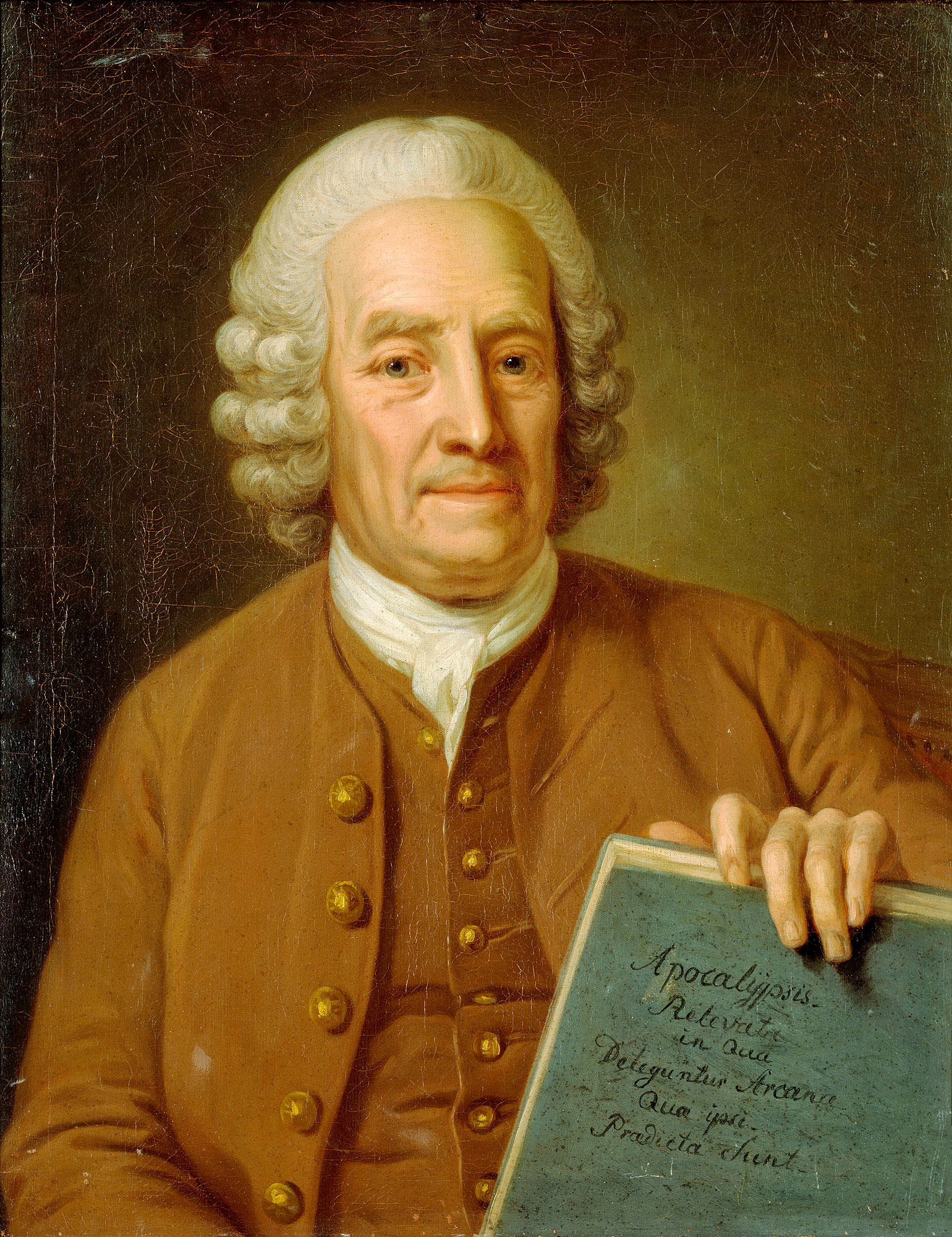
An event in the life of philosopher and mystic Emanuel Swedenborg, as presented at Futility Closet:
On July 21, 1759, Emanuel Swedenborg attended a dinner party after returning to Gothenburg from England. He went out for a short interval and returned pale and agitated. He told the party that a fire had broken out in Stockholm, 250 miles away, and that it was spreading quickly. He said it had already destroyed the house of one of his friends, whom he named, and that his own house was in danger. Two hours later he exclaimed, “Thank God! The fire is extinguished the third door from my house.”

The following morning the governor questioned Swedenborg, who provided a description of the fire, including how it had begun and ended, and word spread throughout the city. Two days later a messenger arrived from Stockholm bearing letters that confirmed Swedenborg’s account, and a royal courier brought news reporting the extent of the fire, the houses it had damaged and destroyed, and the time it was put out. All confirmed Swedenborg’s description.

“What can be brought forward against the authenticity of this occurrence?” wrote Immanuel Kant, who elsewhere criticized Swedenborg’s mysticism. “My friend who wrote this to me, has not only examined the circumstances of this extraordinary case at Stockholm, but also, about two months ago, at Gottenburg, where he is acquainted with the most respectable houses, and where he could obtain the most authentic and complete information, as the greatest part of the inhabitants, who are still alive, were witnesses to the memorable occurrence.”
Posted because a similar, possibly "paranormal" event occurred in my family.  In the 1960s my grandfather was admitted to a hospital after a severe automobile accident.  His children (my mother, aunts, and uncles) gathered at the bedside.  Several days later my uncle Paul arrived.  He had been driving from Minnesota to Seattle and was in the middle of nowhere when he heard his father's voice saying "Paul, come home.  I need you."  He knew it wasn't "real," but it was so compelling an experience that he turned his car around and drove back to Minnesota.   I suppose one can come up with a number of more prosaic explanations involving long-distance phone calls, but there was no apparent reason for him to dissemble about something like this.  I prefer to believe that such things are possible, and beyond the limits of our current understanding.  What kind of rational explanation can one offer for the Swedenborg incident?

"Ear-pull event"

Vanessa Tahbone grimaces while competing against Nicole Colbert during the ear pull event at the 49th Annual World Eskimo-Indian Olympic Games July 23 at the Carlson Center in Fairbanks, Alaska. (AP Photo/Fairbanks Daily News-Miner/Eric Engman)
From the "Big Shots" compilation of the 100 Best Sports Photographs of 2010 (Part 3) at Boston.com's The Big Picture. 
The ear pull is a traditional Inuit game which tests the competitors' ability to endure pain.  In the ear pull, two competitors sit facing each other, their legs straddled and interlocked. A two-foot-long loop of string, similar to a thick, waxed dental floss, is looped behind their ears, connecting right ear to right ear, or left to left.  The competitors then pull upon the opposing ear using their own ear until the cord comes free or one player quits from the pain.  The game has been omitted from some Arctic sports competitions due to safety concerns and the squeamishness of spectators; the event can cause bleeding and competitors sometimes require stitches.
Here's a video of the women's competition in 2007:

The Morske Orgulje (Sea Organ)


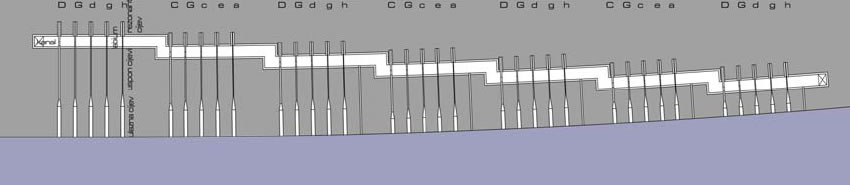
Two art installations in Zadar, Croatia are featured in the video above.  The "Sea Organ" uses the power of ocean waves to generate sounds from organ pipes embedded in a shoreline structure, as explained at OddMusic:
Each musical organ pipe is blown by a column of air, pushed in turn by a column of wave-moved water, through a plastic tube immersed into the water. The pipes' musically tuned sounds emanate to the surroundings through apertures in the vertical planes of the uppermost stairs. The 7 successive groups of musical tubes are alternately tuned to two musically cognate chords of the diatonic major scale. The outcome of played tones and/or chords is a function of random time and space distribution of the wave energy to particular organ pipes.
In this part of Croatia the prevailing musical tradition is the spontaneous four-voice male singing, with melodies and chords conforming to the diatonic major scale. The 5 musically tuned pipes of each section are arranged in 1.5 meter spacings. A listener, standing or sitting on a chosen point on the scalinade, should be able to hear 5 to 7 musically tuned pipes play their natural music. Thus, whole five-pipe sections are tuned to one musical chord. The citizens of Zadar are extremely proud of the first natural musical organ driven by the sea waves ever to be constructed...
The nearby solar-powered light installation is explained at Physics Buzz (whence the video).

Separate hotel entrances for ladies

From Frost’s Laws and By-Laws of American Society: a Condensed but Thorough Treatise on Etiquette and its Usages in America, Containing Plain and Reliable Directions for Deportment in Every Situation in Life, Besides One Hundred Unclassified Laws Applicable to All Occasions, by S. A. Frost, 1869.
Via Centuries of Advice and Advertisements.

The evolution of Barbie dolls

Offered without comment...
Top image source (original unknown).  Bottom image source.

Solanum mammosum

Explained at Kuriositas.

Leonardo da Vinci's bicycle

The photo above depicts a modern model based on the drawing (inset below left), in Milan's Codex Atlanticus, which contains the drawings of da Vinci.
[Augusto Marioni] published his discovery in 1974 in a paper delivered precisely in Vinci, the birthplace of Leonardo. Subsequently the bicycle of Leonardo run a brilliant career, it has been also modeled in life size for the Florentine exhibition in honor of the millennium traveling all over the world. Its only fault was the impossibility of being steered. Apparently this minor problem did not excite the master.

It was only in 1997 that Dr. Hans-Erhard Lessing pointed out in a detailed study that the design was a forgery, and a quite recent one at that, drawn into the codex (!) after its restoration in the 60s, more precisely between 1967 and 1974. No trace of it can be seen on the photos made before and during the restoration, only some circles and lines appear through from the other side of the page, and these were complemented into a bike by the forger.
There's more on this subject at Poemas del rio Wang.

"Ug" has been renamed "Doug"

With his bug eyes, wildly crooked teeth and sparsely-whiskered chin, scrawny Ug sat for months, unclaimed and overlooked at an animal sanctuary. But now, after being dubbed Britain’s ugliest dog, the two-year-old’s less-than-enticing looks have landed him a loving home.

After seeing his profile picture on the the Mayflower animal sanctuary's website, café worker April Parker, 35, immediately fell in love with the partially-blind Pointer cross...

"...he has a fantastic temperament and is really loving.'
 Via Nothing to do with Arbroath.

"Tell me a truth and you shall have your baby back."

Here is a curious old story that is something like a puzzle: A crocodile stole a baby, ‘in the days when animals could talk,’ and was about to make a dinner of it. The poor mother begged piteously for her child. ‘Tell me one truth,’ said the crocodile, ‘and you shall have your baby again.’ The mother thought it over, and at last said: ‘You will not give it back.’ ‘Is that the truth you mean to tell?’ asked the crocodile. ‘Yes,’ replied the mother. ‘Then by our agreement I keep him,’ added the crocodile; ‘for if you told the truth I am not going to give him back, and if it is a falsehood, then I have also won.’ Said she: ‘No, you are wrong. If I told the truth you are bound by your promise; and, if a falsehood, it is not a falsehood, until after you have given me my child.’ Now, the question is, who won?
– Pennsylvania School Journal, March 1887

Found in the always-delightful Futility Closet.

Yukimarimo

"Yuki" means snow in Japanese, and "marimo" is a ball-like growth of water algae which the yukimarimo resemble.

During a storm on the Antarctic plateau the humidity is higher than normal. After a storm, the temperature rapidly drops and and due to the excess humidity, hoarfrost forms on the surface of the snow. At these low temperatures, electrostatic attraction between the rapidly formed ice crystals is high due to growth charging during formation. When a light wind blows after the formation of this hoarfrost, the hoarfrost breaks apart and the frost crystals clump together and stick due to the high electrostatic attraction and subsequent fusing of the ice crystals, and tumble across the snow in a manner similar to tumbleweed.  The sizes of the yukimarimo range from a few millimeters to several centimeters in diameter.
Found serendipitously while researching the post below this one.

Mathematical curiosity

The first few powers of 5 share a curious property — their digits can be rearranged to express their value:

25 = 52
125 = 51 + 2
625 = 56 – 2
3125 = (3 + (1 × 2))5
15625 = 56 × 125
78125 = 57 × 182

It’s conjectured that all powers of 5 have this property. But no one’s proved it yet.
Found in the Futility Closet.

The "wonder cabinets" of the Medicis

The museum’s collection began as the personal wunderkammer of the Medici family. Grand Duke Peter Leopold, embracing the Enlightenment, decided to open this private collection to the general public - men and women, rich and poor - no one was to be excluded from indulging in scientific curiosity. In a time when cabinets of wonder were private and restricted to the upper crust, those could afford the time and money to engage in exotic collecting, this the Grand Duke’s novel idea inspired other institutions to open their doors to the public.
A few more photos are at Curious Expeditions.

A curious orientation of the banisters

"Pender County, North Carolina. Sloop Point at Hampstead. House over 200 years old."
Found at Shorpy.

Nose ring and earrings on a cat

The bronze figure is Egyptian, from the late period (after 600 BC), from the collections of the British Museum.  In addition to the gold rings, the figure has "a silvered collar round its neck and a silver protective wedjat eye amulet.

I'm wondering whether such adornments were placed on the bronze for symbolic/reverential reasons, or whether they portray an actual practice of the time.  Does anyone know if the Egyptians pierced the ears and noses of their cats?  Crazy cat lady - any thoughts??

Photo via Uncertain Times, which has lots of interesting material.

Lyveden New Bield

Lyveden New Bield, a half-completed Elizabethan manor house in Aldwinkle-St-Peter, Northamptonshire. After the death of its commissioners, Sir Thomas Tresham and son in 1605, building work ceased on the site and it has remained abandoned ever since.
Photo credit, via On The Borderland (click photo for wallpaper size).

Is your organ mouseproof?

Via Centuries of Advice and Advertisements.

Addendum: Commenter fillyjonk over at Dustbury.com notes that if there had been a mouseproof organ in Austria in 1818, we might not have the song "Silent Night."

Condoms made from fish swim bladders

This set of 110-year-old condoms, made from the swim bladders of fish, are up for auction in Vienna. Delightfully, they seem to have been meant to be reusable, as evidenced by the former owner's careful tally of how many times each condom had been used. It looks as though you were only supposed to reuse 10 times.
The tally 10/9/8/7... is faintly visible on the red lining of the box, magnified here.

Discovery credit to Dinosaurs and Robots, via BoingBoing.