Showing posts with label history. Show all posts

Mumblety-peg

The term "Mumblety-peg" came from the practice of putting a peg of about 2 or 3 inches into the ground. The loser of the game had to take it out with his teeth. Mumbletypeg was very popular as a schoolyard game in the nineteenth and first half of the twentieth centuries, but with increased concern over child safety the game has declined in popularity...

Mumblety peg is generally played between two people with the aid of a pocket knife. In one version of the game, two opponents stand opposite one another with their feet shoulder-width apart. The first player then takes the knife and throws it to "stick" in the ground as near his own foot as possible. The second player then repeats the process. Whichever player "sticks" the knife closest to his own foot wins the game.

If a player "sticks" the knife in his own foot, he wins the game by default...
Photo reproduction of 1922 magazine page via Centuries of Advice & Advertisement.

Addendum:  Rules here, courtesy of Doc Rock.

A history of disinfected mail

As soon as humans became aware that infectious diseases could be transmitted by fomites (inanimate objects), attention was directed to developing methods of disinfection. Postal and public health authorities had to deal with a wide variety of extremely dangerous infections (cholera, yellow fever, smallpox, leprosy, anthrax), and applied a surprising variety of techniques to letters and packages sent through the mails, beginning as early as the 15th century in Venice.

A very informative philatelic exhibit presents examples of how the U.S. has dealth with potentially dangerous items.  Shown at the top, for example, are two letters from locations where yellow fever was present; they have been punctured to allow fumigating agents to reach the inside of the envelope.  The bottom envelope in this image -
- had its corners clipped off so that formaldehyde gas could be introduced to kill smallpox.  Other letters and postcards were autoclaved or steam sterilized, which could be deleterious to the letters inside.

These precautions were not limited to the preantibiotic era.  In 2001 threats of anthrax attacks were made in the United States, and a variety of special precautions, including x-irradiation, had to be undertaken, beginning at this page of the exhibit and continuing for a dozen pages thereafter.  And these letters from Hawaii in 1900 show how holes were punched in the envelopes -
- so that sulfur fumes could be insufflated before they were sent from areas quarantined for bubonic plague.  Other examples are shown of disinfection of mail from the Hawaiian leper colony.

Philatelic exhibitions are conventionally mounted on a series of glass-fronted frames, with up to 16 letter-size pages in one frame, and in this case spread onto six frames.   This award-winning exhibit was created by William A. Sandrik of Arlington, Virginia.  The entire exhibit may be viewed at Exponet (frame 1, frame 2, frame 3, frame 4, frame 5, frame 6).

And those interested in philately (stamp and postal history collecting) should browse the Exponet site beginning at this index page.  Over 600 exhibits are accessible, on a huge variety of topics, in a wide variety of languages.

State-sponsored sterilization

What these people had in mind was the raising of the genetic good through... forced "asexualization" of the lesser elements of society--forced sterilization of inmates in state-run mental and correctional institutions...

The Human Betterment Society put the issue quite simply in their slim little pamphlet, Human Sterilization--to save ourselves from "race degeneration" society had to act and restrict 'defective" men and women from bearing and rearing children... the country was burdened by as many as 18 Million people with mental disease, who "put a charge and a tax on the population" and who would "cost a billion dollars a year" to take care of...

Dr. William Hutton makes the case for the humanitarian treatment of the treatment espoused in the title of his A Brief for the Sterilization of the Feeble-Minded (1936). "It would be unjust and anti-social to withhold the privilege of sterilization from the victims of mental disorders (the insanities)..."(emphasis mine). He dives into the deep-end of the sterilization issue, making the cse for dealing with the "blind, deaf-mutes, haemophilicacs and brachydactyly (deformed fingers)" in the same manner...

Some states--like Kansas--reached across these lines into the lives of epileptics; Michigan did not hunt for epileptics but did so for "imbeciles". Oregon seemed to cast the widest net, including the "feeble-minded, insane, epileptic, habitual criminals, moral degenerates, and sexual perverts" found in any institution maintained at the public's expense who condition was found to be "inadvisable for procreation".
Further details at Ptak Science Books

Were pygmy mammoths present in ancient Egypt?

Excerpts from an interesting piece at Tetrapod Zoology -
...here's the image, as it appears on the beautifully decorated tomb wall of Rekhmire, 'Governor of the Town' of Thebes, and vizier of Egypt during the reigns of Tuthmose III and Amenhotep II (c. 1479 to 1401 BCE) during the XVIII dynasty...

... drew attention to the small, tusked, hairy elephant in the painting, shown as being waist-high to the accompanying people... Its apparent hairiness, convex back and domed head make it look like a juvenile Asian elephant, but then why it is shown with huge tusks?

Inspired by the then-new discovery that a dwarfed population of Woolly mammoths Mammuthus primigenius were still living as recently as 3700 years ago (albeit on Wrangel Island in the Siberian Arctic: Vartanyan et al. (1993), Guthrie (2004)), Rosen (1994) made the tentative suggestion that the elephant shown in Rekhmire's tomb might actually be a dwarf Woolly mammoth. If true, this would have radical implications. It would mean that the ancient Egyptians had a trading link of sorts with far eastern Siberia, and also that mammoths were captured and then transported alive to Africa!..

... there is then a third possibility: this being that Rekhmire's elephant is neither a Siberian mammoth nor a wrongly-scaled 'symbolic' elephant, but perhaps a depiction of one of the pygmy Mediterranean island-dwelling species. Most of the dwarf Mediterranean elephants were Pleistocene animals that were long gone by the time of the Pharoahs, but Masseti (2001) noted that a population of dwarfed elephants seem to have lingered on in isolation on the Greek island of Tilos (located between Rhodes and Kos)...
More at the link, via BoingBoing.

The Battle of Towton

Excerpts from a very interesting article in The Economist:
[The soldier now known as] Towton 25 suffered eight wounds to his head that day... The first five blows were delivered by a bladed weapon to the left-hand side of his head, presumably by a right-handed opponent standing in front of him. None is likely to have been lethal.

The next one almost certainly was... The blow opened a huge horizontal gash into the back of his head... Fractures raced down to the base of his skull and around the sides of his head...

His enemies were not done yet. Another small blow to the right and back of the head may have been enough to turn him over onto his back. Finally another blade arced towards him. This one bisected his face, opening a crevice that ran from his left eye to his right jaw (see picture). It cut deep: the edge of the blade reached to the back of his throat...

In a letter sent nine days after the battle George Neville, the then chancellor of England, wrote that 28,000 men died that day, a figure in accord with a letter sent by Edward to his mother. England’s total population at the time is thought not to have exceeded 3m people. George Goodwin, who has written a book on Towton to coincide with the battle’s 550th anniversary in 2011, reckons as many as 75,000 men, perhaps 10% of the country’s fighting-age population, took the field that day...

...as a group the Towton men are a reminder that images of the medieval male as a homunculus with rotten teeth are well wide of the mark. The average medieval man stood 1.71 metres tall—just four centimetres shorter than a modern Englishman. “It is only in the Victorian era that people started to get very stunted,” says Mr Knüsel. Their health was generally good. Dietary isotopes from their knee-bones show that they ate pretty healthily. Sugar was not widely available at that time, so their teeth were strong, too...

Arrows were not the only things flying through the air that day. Some of the first bullets were, too. The Towton battlefield has yielded up the earliest lead-composite shot found in England...
Much more at the link.

Saffron

An article (and video) at Russia Today details some of the problems faced by saffron farmers in Kashmir, including damage to traditional fields from pollution.
Costing US$4,000 per kilogram, this pricey ingredient is used in medicine and South Asian cuisine... The biggest long-term challenge is the adulteration of saffron. Cheap, fake brands of saffron sell briskly on the streets of Srinagar. And it is virtually impossible for a non-professional to distinguish between a fake and the real one. This fact has dented saffron's image, and resulted in a drop in prices.
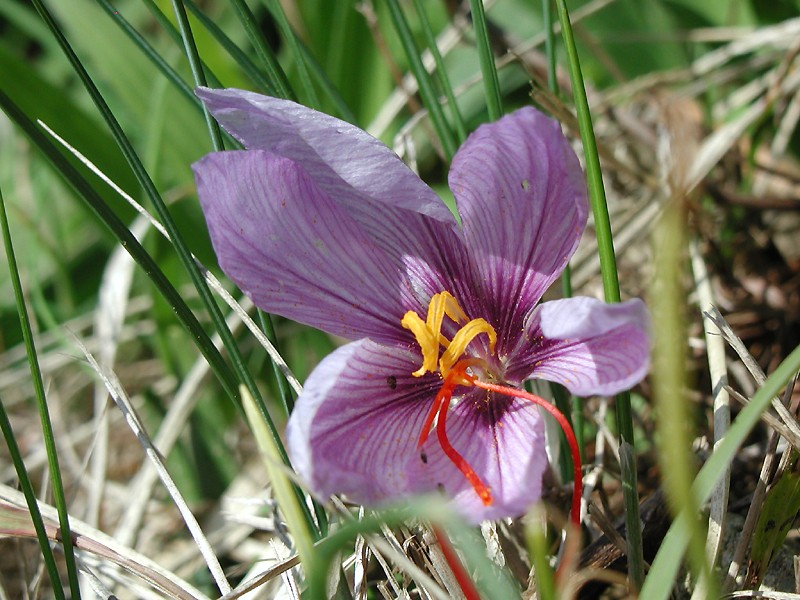
The word "saffron" (and Italian zafferano and Spanish azafrán) come from the Latin word safranum, probably ultimately from Persian and Arabic precursors.  The spice itself is extracted from the saffron crocus (C. sativus).  [The photo above is of non-saffron Wisconsin crocuses].  The following tidbits are excerpted from Wikipedia:
Saffron-based pigments have been found in 50,000 year-old depictions of prehistoric places in northwest Iran. Later, the Sumerians used wild-growing saffron in their remedies and magical potions. Saffron was an article of long-distance trade before the Minoan palace culture's 2nd millennium BC peak... During his Asian campaigns, Alexander the Great used Persian saffron in his infusions, rice, and baths as a curative for battle wounds. Alexander's troops imitated the practice from the Persians and brought saffron-bathing to Greece...

During the 14th century Black Death, demand for saffron-based medicine skyrocketed, and much saffron had to be imported via Venetian and Genoan ships from southern and Mediterranean lands... Cultivation and trade then spread to Nuremberg... Soon after, saffron cultivation spread throughout England, especially Norfolk and Suffolk... By 1730, the Pennsylvania Dutch were cultivating saffron throughout eastern Pennsylvania. Spanish colonies in the Caribbean bought large amounts of this new American saffron, and high demand ensured that saffron's list price on the Philadelphia commodities exchange was set equal to that of gold...

Saffron is widely used in Iranian (Persian), Arab, Central Asian, European, Pakistani, Indian, Turkish, and Cornish cuisines. Confectionaries and liquors also often include saffron. Common saffron substitutes include safflower, annatto, and turmeric...

A pound (454 grams) of dry saffron requires 50,000–75,000 flowers, the equivalent of a football field's area of cultivation... Forty hours of labour are needed to pick 150,000 flowers... The price in Canada recently rose to CAN$18,000 per kilogram. In Western countries, the average retail price is $1,000/£500/€700 per pound (US$2,200/£1,100/€1,550 per kilogram)...

Saffron is graded via laboratory measurement of crocin (colour), picrocrocin (taste), and safranal (fragrance) content. Determination of non-stigma content ("floral waste content") and other extraneous matter such as inorganic material ("ash") are also key... Adulteration was first documented in Europe's Middle Ages, when those found selling adulterated saffron were executed under the Safranschou code. Typical methods include mixing in extraneous substances like beets, pomegranate fibers, red-dyed silk fibers, or the saffron crocus's tasteless and odorless yellow stamens. Other methods included dousing saffron fibers with viscid substances like honey or vegetable oil. However, powdered saffron is more prone to adulteration, with turmeric, paprika, and other powders used as diluting fillers. Adulteration can also consist of selling mislabeled mixes of different saffron grades. Thus, in India, high-grade Kashmiri saffron is often sold and mixed with cheaper Iranian imports; these mixes are then marketed as pure Kashmiri saffron, a development that has cost Kashmiri growers much of their income...
Here's a photo a real saffron crocus (note the red "thread").

Early history of the odometer

Until a couple weeks ago I had assumed that odometers were first developed in conjunction with the automobile.  Then I read about Tycho Brahe's odometer, and decided to research the topic a bit further.  The precursors to mechanical odometers were "bematists" [from the Greek word for a "single pace"] who counted their steps:
Bematists accompanied Alexander the Great on his campaign in Asia. Their measurements of the distances traveled by Alexander's army show a high degree of precision to the point that it had been suggested that they must have used an odometer, although there is no direct mentioning of such a device.
The earliest-recorded mechanical odometers were in Rome and China:
The odometer of Vitruvius was based on chariot wheels... For each revolution a pin on the axle engaged a 400 tooth cogwheel... This engaged another gear with holes along the circumference, where pebbles (calculus) were located, that were to drop one by one into a box. The distance travelled would thus be given simply by counting the number of pebbles...

Chinese texts of the 3rd century tell of the mechanical carriage's functions, and as one li is traversed, a mechanical-driven wooden figure strikes a drum, and when ten li is traversed, another wooden figure would strike a gong or a bell with its mechanical-operated arm...

The Sun Tzu Suan Ching (Master Sun's Mathematical Manual), dated from the 3rd century to 5th century, presented a mathematical problem for students involving the odometer. It involved a given distance between two cities, the small distance needed for one rotation of the carriage's wheel, and the posed question of how many rotations the wheels would have in all if the carriage was to travel between point A and B...
By the nineteenth century, precise odometers such as the one shown at left were being crafted by George Adams of Fleet Street, instrument maker for King George III.

I've not been able to find a link describing the form of odometers in the 16th century, when Brahe was reported to have one on his carriage.

Belgian milk sellers, circa 1890-1900

An example of "Photochrom" photography a century ago.

From the Belgium Library of Congress, via Vintage Photography.

Cynocephaly in portrayals of Saint Christopher

Dog-headed gods were a well-known component of the Egyptian pantheon.  Some Greeks believed that dog-headed people lived in distant lands, and ancient maps sometimes display such creatures in unexplored regions.

But the Christian Saint Christopher is also depicted in this fashion.
Today the legend of St Christopher helping Christ cross the river has obscured the important canine detail: though the river fording is almost certainly a late addition. In the early Middle Ages the most famous thing about St Christopher was his dog’s head. Indeed, good St Chris is often portrayed thus in medieval manuscript and sculpture...

One possible explanation is that Christopher was the Egyptian god Anubis in disguise. This explanationm suffers from a fatal flaw, however: the two have absolutely nothing in common bar their dog head and some associations – vague in the case of Christopher - with Egypt.

The answer is, instead, almost certainly to be found in an early misunderstanding of some of the grains of fact in the Christopher legend... It appears that Christopher served the Empire in the Cohors III Valeria Marmaritarum. If the name of this unit is to be taken at face value then these soldiers were Marmaritae a tribal people dwelling to the south-west of Egypt, outside the Imperial borders...

But what is interesting is that the first surviving description of this corner of the world, in Herodotus no less, tells us that it was here that the dogheads lived. Early on in the tradition of St Christopher an author perhaps innocently made the connection that was then afterwards taken seriously by hagiological duffers...
From Beachcombing's Bizarre History Blog, where there are additional details.

Sixteenth-century book satchel

Described as follows at Christie's:
Probably North Italian, early 16th century.

130 x 100 x 50 mm. Black leather, hardened and cut, the case and lid decorated with a design of oak-leaf wreaths containing a gothic Y, the foliage and initials in relief against a punch-dotted ground, the sides with four raised lion heads forming slots for carrying (the strap is modern)...

Late-medieval cut-leather decoration on bindings and boxes without content or provenance is notoriously hard to localize and date. Many surviving examples are Germanic and Central European, while Italian or French work such as this satchel are rather rarer.
They call it "late-medieval."  Others would probably say this is early Renaissance item.   In either case it just fascinates me to ponder who might have used it and what might have been carried in it.  This item sold for $10,800. 

Via Uncertain Times.

Photos of "Lost London"

Drury Lane.Covent Garden.1880
View in Drury Lane looking south and showing the St Mary le Strand steeple.A 134 foot tall Maypole was erected on the site of the church in 1661 which Alfred Marks describes in 'Photographs of Old London'.He also notes the gabled house in this view was formerly the "Cock and Magpie" tavern "a place of entertainment in the reign of Henry VII."
Wych Street.Covent Garden(?).1880
"These are very good specimens of the overhanging houses of the beginning of the seventeenth century.It is only to be regretted that the extreme narrowness of the street made it impossible to give the full effect of this picturesque group" writes Alfred Marks.He goes on to inform us that Dr.Johnson worshipped at St.Clement Danes Church which can be seen behind the old houses.
White Hart Inn Yard.Borough.1880
"The introduction of the railways has greatly changed the character of these old inns.The 'George' alone seems now to do any considerable business in the 'receipt of travellers';in other cases the business of a tavern has superseded that of an inn and the great courtyards are either being gradually encroached on by warehouses or have been taken up by railway companies as receiving offices."
The Oxford Arms Inn Warwick Lane.City.1875
Just a handful from an assemblage of about three dozen photos at Skyscraper City, via Titam et le Sirop d'Erable.

JFK Library to put all records online

The presidential library commemorating the life of US President John F Kennedy is digitising every scrap of paper, video, audio and artefact it possesses...

Materials already digitised include secret phone conversations about the Cuban missile crisis.  There are also recordings of meetings discussing Vietnam, civil rights and the space race, school report cards and letters from JFK to his mother.

"We are scanning every single piece of paper, movie and audio tape we have in our possession," Tom Putnam, JFK library director told BBC News.

"Unlike other libraries there is no archivist making a decision about what they think you would like to see," he said. "We are showing everything we have."

The library's total archive encompasses 48 million pages, 7,000 hours of audio recordings, 16,000 museum artefacts and 400,000 photographs...

"He gave a speech that said the greatest enemy of truth is often not the lie but the myth," said Mr Putnam. "By having access to this material we hope to give people a much fuller sense of him as a person."
Everything. Wow. "Every single piece of paper..." "No archivist making a decision..." Everything.

Oops. Did I say everything?...
Mr Putnam said missing from the library were materials documenting JFK's dalliances with actress Marilyn Monroe. Also left out are materials on his assassination...
Never mind.

OTMA - the daughters of Tsar Nicholas II

In childhood the grand duchesses came up with ОТМА [Olga, Tatiana, Maria, Anastasia] as a sign of sibling closeness and affection for one another, writing it in their diaries. The girls were great granddaughters of Queen Victoria and, although "thoroughly Russian," grew up speaking both Russian and English fluently among themselves.  Whilst the family was in captivity after the Russian Revolution of 1917 they were allowed to send few letters so the sisters often signed this nickname on cards they had written together for loved ones and friends.
I can't look at the photo without thinking of how the bullets were said to have richocheted off the jewels hidden in their clothing when they were executed.

From the Flickr photostream of Art & Vintage, via Sloth Unleashed.

Propellor-propelled automobile

I saw this photo at Lushlight and assumed it was an eccentric inventor's one-off, but a little searching revealed more information:
Leyat was a French automobile manufacturer established by Marcel Leyat in 1919 in Paris... The first model was called Hélica, also known as 'The plane without wings'. The passengers sat behind each other as in an aircraft. The vehicle was steered using the rear wheels and the car was not powered by an engine turning the wheels, but by a giant propeller powered by an 8 bhp (6.0 kW) Scorpion engine. The entire body of the vehicle was made of plywood, and weighed just 250 kg (550 lb), which made it dangerously fast.

In 1927, A Hélica reached the speed of 106 mph (171 km/h) at the Montlhéry circuit. Leyat continued to experiment with his Helica, he tried using propellers with two and four blades. Between 1919 and 1925, Leyat managed to sell 30 vehicles.
That is impressive for the era.  I also found a page showing all of the Helica models from 1913-1933, including these:

More at the link, which is in French.

Genetic map of the Habsburg Jaw

The jaw, as seen in Rudolph II -
And the genetic map of the trait -
Interesting how it becomes more common as the generations continue to inbreed.  More details in this prior post.

Painting: Joseph Heintz the Elder: Emperor Rudolf II, c. 1592 © Kunsthistorisches Museum /Kunsthistorisches Museum Vienna.

An unusual cemetery in northern Iran

Three shrines and hundreds of tombstones left by an unknown people -
The cemetery lays in the northern part of Golestan province, in the mountains of Torkaman Sahra (Turkmen Desert) near the border with Turkmenistan... The holy place encompasses actually not one but three shrines, revered by local tradition as the tombs of the prophet Khaled Baba, his father-in-law Alaam Baba and his shepherd Chupan Ata...

Prophet Khaled himself is claimed in the legend hanging on the wall of the sanctuary to have been born in Yemen, his father was called Sanan, and he died here in 528, that is 42 years before the birth of Mohamed and 82 years before the beginning of Mohamed’s prophetic mission. The obvious question concerning the faith of which he was a prophet eighty-two years before the very foundation of Islam, is not raised in the legend. However, it is very probable that he was a Nestorian Christian, one of those who in this period migrated in a growing number to the north-eastern regions of the Persian empire, and from there further to China along the Silk Road...

In the cemetery laying a few hundred meters from the shrines around six hundred tombstones have been preserved. The stones are basically two kinds: either long columns ending in round hats which are sometimes two meters high or more, or smaller, squat grave posts similar to a cross where the two arms of the cross are replaced by two semi-circles or almost complete circles...

...if we project these places on the map, we see that almost all of them lay north of the majestic Gorgan Wall, built several centuries before Christ which, stretching from the Caspian Sea to the Afghan mountains, defended Iran from the attack of the northern tribes (and which was first excavated by the Hungarian Aurel Stein in 1915). Perhaps these cemeteries belonged to such tribes of the steppe, which would also give an explanation for the lack of any settlement around them.
If this interests you, there is more information and about three dozen more photos at Poemas del rio Wang.  I'm also intrigued by the reference to the Great Wall of Gorgan, the second longest in the world.  I have walked on the Great Wall of China and Hadrian's Wall and visited the Berlin Wall, but have never even heard of this one.  You learn something every day.

Is $10 billion buried on Robinson Crusoe Island?

Or is this just hype to encourage visits by tourists?  This from last month's Santiago Times:
Keiser, whose treasure-seeking effort on the island the past 12 years has cost him an estimated US$2 million, is reportedly in the process of shelling out another US$100,000 dollars for this latest effort, which includes highly sophisticated mining video technology.

But Keiser’s expenses will be well covered should he find the treasure: Chilean law will provide him 25 percent of any booty he discovers, and Keiser estimates the treasure’s value at US$10 billion.

According to legend, the treasure originated in the Incan Empire and was stolen during the Spanish conquest of Peru in the 16th and 17th centuries. When the treasure was en route to Spain around 1715, the navigator in charge of the ship landed on Robinson Crusoe Island and buried his cargo. Before he could return to unearth the booty, an English pirate named Cornelius Webb uncovered the Incan treasure and reburied it elsewhere on the island. The legendary stash is reported to contain 800 barrels of gold, including precious pieces of gold and jewelry.
More details on the story of the treasure and new developments in the quest are available at Death by 1000 Papercuts.  See also my two posts in 2009 about archaeological digs on the island, here and here.

Sailing on the beach, 1900

Photo taken at Ormond, Florida, about 1900.  It's a posed photo on a stationary vehicle.  The problem of "coming about" with a "deck sweeper" boom is noted at Shorpy, where you can view a larger image.

We'll Meet Again (Vera Lynn, 1939)


For New Year's Eve, instead of embedding fireworks I've chosen a classic song. "We'll Meet Again" was a signature tune of World War II:
The song... resonated with soldiers going off to fight and their families and sweethearts. The assertion that "we'll meet again" is optimistic, as many soldiers did not survive to see their loved ones again. Indeed, the meeting place at some unspecified time in the future would have been seen by many who lost loved ones to be heaven.
There have been many versions as modern performers have covered the piece, but Vera Lynn is the obvious choice, since she popularized the song during the war, and it became one of her signature pieces. The video of this song most often seen is the one using the final moments of Dr. Strangelove, but those images of nuclear blasts were a little too dismal for tonight; I thought this one employing stills from WWII was at least a bit more upbeat.

The message of the song is for all TYWKIWDBI visitors, especially the old-timers. It has been an interesting year; I've enjoyed having your company for this curious adventure. We'll meet again - tomorrow...

Update: The Guardian has a story about Vera Lynn at age 92, and about the upcoming publication of her autobiography.

Second update: Originally posted last New Year's eve, now reblogged in view of this news -
...at the age of 92, she has done it again, hitting No 1 in the album charts last night with her offering We'll Meet Again: The Very Best of Vera Lynn and usurping Bob Dylan, 68, as the oldest artist to grace the top spot... Her album fought off stiff competition from the Beatles, who occupied the 5th, 6th, 9th, 10th, 21st, 24th, 29th, 31st, 33rd, 37th and 38th spots...

It is 70 years to the month since Lynn, then 22, first recorded We'll Meet Again, which became a symbolic song of the second world war... Last night's No 1 made her the only artist to feature in the UK single and album charts in the 20th and 21st centuries.
Third update:  I needed some music to post on New Year's Eve, so this repost finds life once more.  See you guys next year...

Auld Lang Syne


Should auld acquaintance be forgot,
and never brought to mind ?
Should auld acquaintance be forgot,
and days of auld lang syne ?

CHORUS:
For auld lang syne, my jo,
for auld lang syne,
we’ll tak a cup o’ kindness yet,
for auld lang syne.

And surely ye’ll be your pint-stowp !
and surely I’ll be mine !
And we’ll tak a cup o’ kindness yet,
for auld lang syne.

CHORUS

We twa hae run about the braes,
and pu’d the gowans fine ;
But we’ve wander’d mony a weary fit,
sin auld lang syne.

CHORUS

We twa hae paidl’d i' the burn,
frae morning sun till dine ;
But seas between us braid hae roar’d
sin auld lang syne.

CHORUS

And there’s a hand, my trusty fiere !
and gie's a hand o’ thine !
And we’ll tak a right gude-willy waught,
for auld lang syne.

CHORUS
Robert Burns sent a copy of the original song to the Scots Musical Museum with the remark, “The following song, an old song, of the olden times, and which has never been in print, nor even in manuscript until I took it down from an old man".  Some of the lyrics were indeed "collected" rather than composed by the poet; the ballad "Old Long Syne" printed in 1711 by James Watson shows considerable similarity in the first verse and the chorus to Burns' later poem, and is almost certainly derived from the same "old song". It is a fair supposition to attribute the rest of the poem to Burns himself...

Most common use of the song involves only the first verse and the chorus. The last lines of both of these are often sung with the extra words "For the sake of" or "And days of", rather than Burns' simpler lines. This allows one note for each word, rather than the slight melisma required to fit Burns' original words to the melody...
Lyrics and text from Wikipedia (where's there's also a useful "English translation".)