Showing posts with label business. Show all posts

Commodity price inflation

I've written about this a number of times in the blog, but there are two more interesting articles this week.  One in the Wall Street Journal explains how the increases jump across categories:
It's getting pricier to throw some ribs and burgers on the grill. And you can blame the surging price of corn. That's because much of the corn grown in the U.S. is used as animal feed. And "we're using $6 corn to feed hogs right now," up from about $4 last year... So if you "want barbecue ribs," he adds, "you're going to have an extra $10 attached to it."...

The United Nations' Food and Agriculture Organization's monthly Food Price Index, which monitors the monthly change in a basket of commodities including meat, dairy and sugar, rose for the sixth straight month in December to its highest level since 1990....

In some cases, prices may not rise, but you will see fewer discounts or get less for your money. For instance, because of sugar prices' 30-year high in late December, packages are expected to shrink to a four-pound bag, from a five-pound bag, Mr. Swanson says. "You're getting 20% less" for the same price, he says....

Cotton futures prices skyrocketed 92% in 2010, thanks to growing demand as well as floods in Pakistan and heavy rains in China that damaged crops... Retail prices of jeans are expected to increase this year by 4.3%, socks 2.7%, sweatshirts and sweatpants 2.4%, polo shirts 2% and T-shirts 1.8%, according to industry group Cotton Inc.

Mens' clothes, in particular, are expected to get a bigger price bump because more of the garments contain cotton (compared with apparel for women and children) and they're a heavier weight with a higher cotton content....
And an article at the Guardian suggests that it's not just bad weather and increased demand that increases commodity prices. There is also pressure generated by speculators:
The same banks, hedge funds and financiers whose speculation on the global money markets caused the sub-prime mortgage crisis are thought to be causing food prices to yo-yo and inflate. The charge against them is that by taking advantage of the deregulation of global commodity markets they are making billions from speculating on food...

When this process of "hedging" was tightly regulated, it worked well enough. The price of real food on the real world market was still set by the real forces of supply and demand. But all that changed in the mid-1990s. Then, following heavy lobbying by banks, hedge funds and free market politicians in the US and Britain, the regulations on commodity markets were steadily abolished. Contracts to buy and sell foods were turned into "derivatives" that could be bought and sold among traders who had nothing to do with agriculture. In effect a new, unreal market in "food speculation" was born...

...the markets are now heavily distorted by investment banks: "Let's say news comes about bad crops and rain somewhere. Normally the price would rise about $1 [a bushel]. [But] when you have a 70-80% speculative market it goes up $2-3 to account for the extra costs...

Last year, London hedge fund Armajaro bought 240,000 tonnes, or more than 7%, of the world's stocks of cocoa beans, helping to drive chocolate to its highest price in 33 years. Meanwhile, the price of coffee shot up 20% in just three days as a direct result of hedge funds betting on the price of coffee falling...
More at the link.  Sounds like the plot of a Frank Norris novel I read in college.

The Vermont legislature tackles "corporate personhood"

A year ago today, the Supreme Court issued its bizarre Citizens United decision, allowing unlimited corporate spending in elections as a form of “free speech” for the corporate “person.”...

In Vermont, state senator Virginia Lyons earlier today presented an anti-corporate personhood resolution for passage in the Vermont legislature. The resolution, the first of its kind, proposes "an amendment to the United States Constitution ... which provides that corporations are not persons under the laws of the United States." Sources in the state house say it has a good chance of passing...

The resolution goes on to note that "large corporations own most of America's mass media and employ those media to loudly express the corporate political agenda and to convince Americans that the primary role of human beings is that of consumer rather than sovereign citizens with democratic rights and responsibilities."

Denouncing this situation as an "intolerable societal reality," the document concludes that the "only way" toward a solution is the amendment of the Constitution "to define persons as human beings.”...

There is a groundswell of support: 76 percent of Americans, according to a recent ABC News poll, said they opposed the Citizens United decision.
Excerpted from an article at AlterNet.

Legally mandated holidays and vacation leave

Posted because in my pre-blogging, prime employment years, I had to go to work on most of the federally-recognized "holidays."

Found via Reddit, where there is some relevant discussion.

Placebo power bands

From a report at the BBC about a new trend among celebrities and athletes:
It's a Power Balance bracelet - a silicone band with a hologram. They are an increasingly common sight on the golf course, and away from sport both Robert De Niro and Kate Middleton have been spotted wearing them...

The bracelet's distributors in Australia have just had to apologise and change their marketing and advertising text after the Australian Competition and Consumer Commission took action. The commission said that the local distributors had claimed the bands would "improve balance, strength and flexibility". They also criticised the slogan "Performance Technology". The distributors admitted no credible scientific basis for the claims, the commission said.

On the US website of Power Balance it explains the bands thus: "Power Balance is based on the idea of optimising the body's natural energy flow, similar to concepts behind many Eastern philosophies. The hologram in Power Balance is designed to resonate with and respond to the natural energy field of the body."..

John Porcari, a professor in the department of exercise and sport science at the University of Wisconsin-La Crosse, recently tested 42 student athletes in an experiment. Balance, flexibility, strength and vertical jump were tested, while the athletes wore either a Power Balance band or a generic rubber band. Both the athletes and the testers did not know which was being worn while the experiment was conducted.

There was no difference between the bands, but there was a marked improvement in tests which were being done by an athlete for the second time. This suggests that once people know what is coming, they prepare themselves and perform better in the test. And that's without even considering the possible placebo effect, the idea that the psychological boost of believing in the bands can improve performance...

"I was really impressed by the marketing. They have managed to get away without deceiving anyone in the sense of an overt lie. There are no claims on the packaging itself. "They don't make any reference at all to any health outcomes. They leave that as an inference that most people will draw."

Even the £30 cost may help with the psychological effect of a band. "There is some evidence to show that the more expensive a placebo is, the more of a placebo effect it has."
I don't believe the cricketers and golfers and celebrities believe in the power of the band. They are well paid to wear it, just like the logos on their clothes.

The revolving door for retired military generals

From a detailed report at the Boston Globe:
The Globe analyzed the career paths of 750 of the highest ranking generals and admirals who retired during the last two decades and found that, for most, moving into what many in Washington call the “rent-a-general’’ business is all but irresistible.

From 2004 through 2008, 80 percent of retiring three- and four-star officers went to work as consultants or defense executives, according to the Globe analysis. That compares with less than 50 percent who followed that path a decade earlier, from 1994 to 1998.

In some years, the move from general staff to industry is a virtual clean sweep. Thirty-four out of 39 three- and four-star generals and admirals who retired in 2007 are now working in defense roles — nearly 90 percent...

■ Dozens of retired generals employed by defense firms maintain Pentagon advisory roles, giving them unparalleled levels of influence and access to inside information on Department of Defense procurement plans.

■ The generals are, in many cases, recruited for private sector roles well before they retire, raising questions about their independence and judgment while still in uniform. The Pentagon is aware and even supports this practice...

■ When a general-turned-businessman arrives at the Pentagon, he is often treated with extraordinary deference — as if still in uniform — which can greatly increase his effectiveness as a rainmaker for industry...
The rest of the story is at the Boston.com link, via The Atlantic.

Large corporations masquerade as small businesses

A column at Counterpunch cites the example of California's wine industry:
These activities are capital-intensive. For those with enough pre-existing wealth to shoulder the heavy up-front costs, the profits can be enormous... ownership of the industry has grown increasingly concentrated. Most vineyard acreage in the region is ruled by a small collection of massive multi-national corporate conglomerates, which typically boast annual revenues greater than a billion dollars.

To hear the patriarchs of the wine industry tell it, by contrast, the typical area wine-making operation is a “bucolic,” family-owned business...

In reality, while there remain some area vineyards that possibly fit the Wine Commission web site characterization, a huge portion of Mendo's vineyard acreage is owned by corporate conglomerates that belong to the billion-dollar-a-year set. Most of the other wine-grape plantations are remotely controlled by decidedly non-local corporations with revenues of at least $50 million a year...

Over the years, wine industry robber-baron Jess Jackson has gone to perhaps the most absurd lengths of all to garb his company in a rustic wine-maker mystique. The company no longer refers to itself as Kendall-Jackson, but rather as Jackson Family Wines... “Little Guy” Jackson landed in the upper half of Fortune magazine's 2003 ranking of the world's 500 richest people, with personal wealth of $1.8 billion...

More to the point, the profits generated by local vineyards accrue almost entirely to the wine industry big boys. Just seven global wine conglomerates purchase the vast majority of wine grapes grown in the United States. The majority of these are grown in California. These companies produce 82 percent of all wine sold throughout the country. The majority of these enormous companies are integrated with other units of Big Alcohol; namely, spirits and beer.

The upshot? Regardless of who runs the actual grape production side, it's the large multi-nationals that ultimately reap the benefits of the local wine-growing economy – just as with virtually every other sector of America's agribusiness enterprise – at the expense of just about everyone and everything else...

As Wendell Berry has written regarding the corporate agribusiness model in general, “To put the bounty and health of our land, our only commonwealth, into the hands of people who do not live on it and share its fate will always be an error. Whatever determines the fortune of the land determines also the fortune of the people. If history has taught us nothing else, it has taught us that.”
More at the link, and more articles coming on this topic.

Cinematic product placement, 1951

A hat tip to Peter Osgood, who posted the following item at a board discussing the King William's College quiz:
In John Huston's The African Queen (1951), Gordon's was the brand of choice for Charlie Allnut, the hard-drinking riverboat captain, played by Humphrey Bogart.  The Gordon's label is clearly shown in a pivotal scene in which Katharine Hepburn's teetotaling character, Rose Sayer, tosses crates of the beverage into the river.  The appearance of Gordon's gin in The African Queen is frequently cited as one of the first examples of movie product placement.
Photo from Poster Art.  It looks more like a publicity still than a movie screencap.

Are bookstores becoming "showrooms for books" ??

A report in the StarTribune details the declining number of independent bookstores in the Twin Cities:
In a shakeout inducing shivers to rival a suspense novel, one local independent bookseller after another is closing up shop... "We have lost a lot of regular customers to the e-book revolution," said owner Charlie Leonard.

Booksellers are calling the shift a "Gutenberg moment" for the entire publishing industry, likening it to Johannes Gutenberg's game-changing invention of movable type almost 600 years ago.

E-books aren't the only adversary, of course; people are buying fewer books in general. Still, dusting bookshelves in the digital age is starting to feel a bit quaint...

Lately, she said, more customers are browsing to decide which books to download at home. "We're really now a showroom for books.''

The number of independent bookstores has been declining for some time, from about 6,000 in the early 1990s to about 2,200 today, according to the American Booksellers Association...

"I used to have Boy Scouts who would go to garage sales and buy a book for 50 cents and sell it to me for $2," Cummings said. "They don't need me anymore. They can do it themselves" online.

"Trickle-down" economics proven valid


Just ask Sotheby's, Manhattan jewelers, upscale restaurants...

The video presentation was created for RT, which I presume is Russia Today (not Radio Times of the BBC), so they may have an agenda.  Of course, everyone has an "agenda" - the larger question is whether the information presented is incorrect in any way....

An interview with WikiLeaks' Julian Assange

From an interview by Andy Greenberg, posted at Forbes:
In a rare, two-hour interview conducted in London on November 11, Assange said that he’s still sitting on a trove of secret documents, about half of which relate to the private sector. And WikiLeaks’ next target will be a major American bank. “It will give a true and representative insight into how banks behave at the executive level in a way that will stimulate investigations and reforms, I presume,” he said, adding: “For this, there’s only one similar example. It’s like the Enron emails.”

You once said to one of my colleagues that WikiLeaks has material on BP. What have you got?

We’ve got lots now, but we haven’t determined how much is original. There’s been a lot of press on the BP issue, and lawyers, and people are pulling out a lot of stuff. So I suspect the material we have on BP may not be that original. We’ll have to see whether our stuff is especially unique...

Continuing then: The tech industry?

We have some material on spying by a major government on the tech industry. Industrial espionage...

Do you have more on finance?

We have a lot of finance related things. Of the commercial sectors we’ve covered, finance is the most significant...

How do businesses need to adjust to a world where WikiLeaks exists?

WikiLeaks means it’s easier to run a good business and harder to run a bad business, and all CEOs should be encouraged by this. I think about the case in China where milk powder companies started cutting the protein in milk powder with plastics. That happened at a number of separate manufacturers.

Let’s say you want to run a good company. It’s nice to have an ethical workplace. Your employees are much less likely to screw you over if they’re not screwing other people over.

Then one company starts cutting their milk powder with melamine, and becomes more profitable. You can follow suit, or slowly go bankrupt and the one that’s cutting its milk powder will take you over. That’s the worst of all possible outcomes.

The other possibility is that the first one to cut its milk powder is exposed. Then you don’t have to cut your milk powder. There’s a threat of regulation that produces self-regulation.

It just means that it’s easier for honest CEOs to run an honest business, if the dishonest businesses are more effected negatively by leaks than honest businesses. That’s the whole idea. In the struggle between open and honest companies and dishonest and closed companies, we’re creating a tremendous reputational tax on the unethical companies.

No one wants to have their own things leaked. It pains us when we have internal leaks. But across any given industry, it is both good for the whole industry to have those leaks and it’s especially good for the good players.
The full interview is here, via Reddit.

eBay transactions on Black Friday

The data ("all U.S. buyer and seller transactions") are from last year, originally posted by TechCrunch.  It's an interesting distribution; I wish someone could adjust it for population density.  Via Sociological Images.

Why stock prices and commodities sometimes track one another

In the past few years, many investors have concluded that commodities like oil, corn and gold offer independent returns that can diversify away the risks of stocks. But the correlations between stocks and commodities—the extent to which their prices move together—are in many cases the highest they have been in nearly 30 years...

Some of the linkages between stocks and commodities are looking bizarre. This Thursday, the monthly correlation between sugar futures and the S&P 500 hit 67%, more than 10 times its level just six days earlier, says Howard Simons, strategist at Bianco Research. That is the third time this year that the linkage between sugar and stock prices surged above 60%—much higher than their long-term average of under 20%...

Sugar, says Mr. Simons, is now both an "energy commodity" and a "growth story," since much of the Brazilian crop is used to produce ethanol. That gasoline additive is linked to crude-oil prices, which in turn are sensitive to monetary policy and global economic growth—the same factors driving stock prices...

But there is another, less visible force at work, Mr. Simons says. Algorithmic trading programs, or "algos," automatically buy and sell a wide variety of assets based on mathematical models. An algo doesn't know or care why two assets are moving together; it merely is programmed to recognize that they are doing so. As soon as a computer places bets that such a linkage in prices will persist, other traders—computers and humans alike—tend to take note and follow suit...

"We've gotten to the Frankenstein point where algos are self-programming, and they evolve to chase these relationships," Mr. Simons says. "That's created a sheer wall of money that is forcing other people's behavior into the same pattern."

...And you may have been riding the commodity boom without even realizing it. "It's a common assumption that the average individual investor has zero allocation to commodities," says Matthew Carvalho, director of investment research at Loring Ward, a financial-advisory firm in San Jose, Calif. "But most investors have some indirect exposure to commodities through the stock market."
Further details at The Wall Street Journal.  Some day I ought to write a long post about algorithmic trading programs, the thought of which frankly scares the bejeesus out of me.

Where does the Chamber of Commerce get its money?

From membership fees by small businesses?   Well, not exactly...
The U.S. Chamber of Commerce astonished even the most jaded Washington-watchers last year when it reported spending nearly $150 million on lobbying. The figure obliterated all previous records and cemented the chamber's reputation as Capitol Hill's most formidable lobbying force.

But it turns out that a lot of that money came from an injection of funds from another lobbying powerhouse: America's Health Insurance Plans.

The private insurers' group gave $86.2 million toward the chamber's media and lobbying blitz against President Obama's health-care legislation in 2009 even as it was pledging general support for the idea of reform, according to tax records and sources familiar with the gift.

The donation made AHIP the chamber's single largest funder in 2009, accounting for about 40 percent of the business lobby's $205 million in contributions that year, records show. 
The rest of the story is at the Washington Post link.

Ted Koppel excoriates current-day "news" reports

In a Washington Post column, Koppel discusses Keith Olbermann ("the most opinionated among MSNBC's left-leaning, Fox-baiting, money-generating hosts") and other television news commentators.  Some excerpts from this most excellent rant:
We live now in a cable news universe that celebrates the opinions of Olbermann, Rachel Maddow, Chris Matthews, Glenn Beck, Sean Hannity and Bill O'Reilly - individuals who hold up the twin pillars of political partisanship and who are encouraged to do so by their parent organizations because their brand of analysis and commentary is highly profitable.

The commercial success of both Fox News and MSNBC is a source of nonpartisan sadness for me. While I can appreciate the financial logic of drowning television viewers in a flood of opinions designed to confirm their own biases, the trend is not good for the republic...

Beginning, perhaps, from the reasonable perspective that absolute objectivity is unattainable, Fox News and MSNBC no longer even attempt it. They show us the world not as it is, but as partisans (and loyal viewers) at either end of the political spectrum would like it to be...

...when our accountants, bankers and lawyers, our doctors and our politicians tell us only what we want to hear, despite hard evidence to the contrary, we are headed for disaster. We need only look at our housing industry, our credit card debt, the cost of two wars subsidized by borrowed money, and the rising deficit to understand the dangers of entitlement run rampant. We celebrate truth as a virtue, but only in the abstract...

Much of the American public used to gather before the electronic hearth every evening, separate but together, while Walter Cronkite, Chet Huntley, David Brinkley, Frank Reynolds and Howard K. Smith offered relatively unbiased accounts of information that their respective news organizations believed the public needed to know. The ritual permitted, and perhaps encouraged, shared perceptions and even the possibility of compromise among those who disagreed...

There is, after all, not much of a chance that 21st-century journalism will be adapted to conform with the old rules. Technology and the market are offering a tantalizing array of channels, each designed to fill a particular niche - sports, weather, cooking, religion - and an infinite variety of news, prepared and seasoned to reflect our taste, just the way we like it. As someone used to say in a bygone era, "That's the way it is."
Much more at the link.

A critical view of Ted Koppel and his biases is at this link (hat tip to Stan B.)

Photo credit.

How some American "founding fathers" became wealthy

“Land speculation was the main investment scheme of the age. It had been carried out with great appetite in colonial America, where large grants of land, often hundreds of thousand of acres, could be obtained from the Crown or from the colonial governments for a pittance. In 1748, for example, a group of influential Virginians formed the Ohio Company and secured half a million western acres; the following year, the Loyal Company, also composed of leading Virginians, acquired 800,000 acres. With a minimal investment, speculators could turn an exorbitant profit reselling land parcels to settlers. George Washington, Benjamin Franklin, Patrick Henry, and other founding fathers were all land speculators on a grand scale.” (p. 27)
-- from Jay Feldman, When the Mississippi Ran Backwards: Empire, Intrigue, Murder, and the New Madrid Earthquakes. Free Press, New York, 2005.

About those glasses in your hotel room

"Fox Atlanta set up secret cameras inside 5 different hotel chains from the Holiday Inn to the Ritz Carlton and caught every single one of them failing to properly wash the room's glasses. At every single hotel, regardless of price, the glasses were simply rinsed out and left for the next guest. Some hotels used dirty bath towels to wipe the glasses. One hotel employee rinsed the glasses after cleaning the toilet—using the same gloves."

The value of "dirty jobs"

Excerpts from an interview with Mike Rowe, who hosts the Discovery Channel's "Dirty Jobs."
MIKE ROWE: Attitudes toward hard work have changed, and not for the better. Many people view dirty jobbers with a mix of pity and derision. Some ignore them altogether. However, one thing is unchanged: People with dirty jobs make civilized life possible for the rest of us. For that reason, I see a willingness to get dirty as a mark of character.

G: Why don’t more people respect dirty jobs?
MR: Once upon a time, we were proud to be dirty. Dirt looked like work, and work was revered. Now, we’ve redefined our notion of what a “good job” looks like. We’ve taken the “dirt” out of the formula, and in the process, marginalized a long list of important professions. Big mistake...

G: So you’re anti-college?

We’ve been gradually training our kids to equate dirt with vocational dissatisfaction. The real enemies of job satisfaction are drudgery and boredom, and those can be found just as readily in cubicles as they can in ditches...

There is nothing wrong with getting a college degree. The flaw in our character is our insistence on separating blue-collar jobs from white-collar jobs, and encouraging one form of education over another. Why do we value one above the other, when our future depends upon both? That’s our blind spot. 
My own dirtiest jobs were greasing cooker machines in a Green Giant canning plant, and cleaning bedpans (and buttocks) as an orderly.  After that I spent many years teaching in the technical institute affiliated with the University of Kentucky, and I can guarantee you that the students there went on to careers just as satisfying and probably just as well-paying as most of their counterparts in the four-year degree program.

Via Reddit, where there is a long discussion thread about the value of college and of manual labor.


Musing about corn

In the Upper Midwest, this is the season for corn mazes.  (This past weekend I also drove past a "corn maze for blondes" which I didn't photograph; you'll need to use your imagination).

When I was growing up in Minnesota, a cornfield was the very essence of rural America and a defining factor for the family farm (I understand things would be different in cotton country or wheat country).  Here's a great map of "land cover" in the Upper Midwest, from GIS and Science, showing the "corn belt" of the U.S. in yellow:
Some of my earliest memories are of the cornfields on my grandparents' farm (in one of those bright yellow southern Minnesota counties), and of walking with my dad down cornrows in southwestern Minnesota while hunting pheasants.  We had two golden retrievers, neither of whom were properly trained, who when taken on a hunt for pheasants would rush down the cornrows and flush the birds hundreds of yards away, much to my father's frustration.  Now in retrospect I'd like to think that Champ and Sport had a hidden agenda of warning the pheasants ("flee for your lives!").
During my years in urban Massachusetts, Texas, Kentucky, Indiana, and Missouri I didn't realize how much I missed the cornfields.  Ten years ago our careers brought us back to Wisconsin, and we found a home on a dead-end street where the cul-de-sac terminates at forty acres of corn.  I also see corn when I'm hiking, since many of my favorite trails abut farmland.

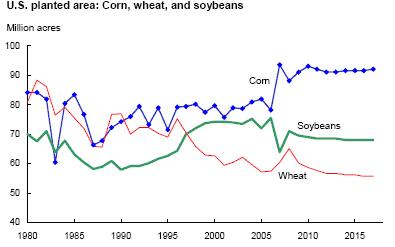
In these past ten years, I've thought I detected a change; the cornfields seemed to be increasing.  At the micro level, I've noticed it where I hike; the farmers have been swinging their cultivators a bit wider each year, trying to get in a extra row or two of planting.  On the macro level, I seem to see corn where there wasn't corn before.  A search this morning yielded this graph:
Those data come from 2008, and confirmed all-time record acreage planted in corn.  I presume the trend is continuing.  Those increased plantings are not to supply the sweet corn that I love.  In Wisconsin, of the 3.9 million acres of corn planted in 2010, only 83,300 acres are sweet corn; that's about 1 acre in each 40.  So the way I think of that field at the end of my road is that it has one acre of "eating'" corn, and 39 acres of corn for ethanol, polymers, cattle and hog feed, gluten, corn oil, high fructose corn syrup, and other products.  Now when I look at a cornfield, what I see is not a scene of pastoral tranquility; I see a factory.

I can't really say with any conviction that this is "wrong."  It's just the way things are, and it reflects a reality that has changed during my lifetime.  Others are not so sanguine about the changes; for an article by someone with practical experience in the corn business I would offer this letter from the Daily Yonder.
Credit for the corn maze photo to Greg Dixon at Madison.com.  The other two are mine.

Sidewalk art sale

"On a side street today I found two little girls running an "art stand", where they were selling drawings for 75 cents. One said "we usually do lemonade stands, but wanted to see if we could make money doing what we really like". Totally worth investing a couple of dollars in :)
Posted by karmacist at Reddit, where the drawing and the concept are discussed (the name of the artist has been blurred in the image for privacy concerns).

"Privatizing" public libraries

Excerpts from a story in the New York Times:
A private company in Maryland has taken over public libraries in ailing cities in California, Oregon, Tennessee and Texas, growing into the country’s fifth-largest library system...

The company, known as L.S.S.I., runs 14 library systems operating 63 locations. Its basic pitch to cities is that it fixes broken libraries — more often than not by cleaning house.  “A lot of libraries are atrocious,” Mr. Pezzanite said. “Their policies are all about job security. That’s why the profession is nervous about us. You can go to a library for 35 years and never have to do anything and then have your retirement. We’re not running our company that way. You come to us, you’re going to have to work.”

Until now, the three branch locations have been part of the Los Angeles County library system. Under the new contract, the branches will be withdrawn from county control and all operations — including hiring staff and buying books — ceded to L.S.S.I...

Library employees are often the most resistant to his company, said Mr. Pezzanite, a co-founder of L.S.S.I. — and, he suggested, for reasons that only reinforce the need for a new approach.

“Pensions crushed General Motors, and it is crushing the governments in California,” he said. While the company says it rehires many of the municipal librarians, they must be content with a 401(k) retirement fund and no pension...
More at the link, although it doesn't explain how the company will make a profit running the libraries.  Presumably they receive a fee from the state, and then run the library for less than the fee amount. (?)