The phrase refers to a disease caused by Phytophthora ramoru, a fungus that affects oaks and other plants. The Guardian had an article today about the devastation occurring in parts of the U.K. -
In woodlands around the UK, just as here in Afan Valley, south Wales, the race is on to fell thousands of trees in a desperate effort to contain a new disease which poses a threat to British forests on a scale not seen since Dutch elm disease wiped out millions of trees, changing the landscape of the country for ever.
Already 3,000 hectares of larch forest – one hectare is about the size of a football pitch – in Wales, Devon, Cornwall, Somerset and Northern Ireland are known to be infected by Phytophthora ramorum – sudden oak death – which comes from the same family as the potato blight organism that caused the Irish famines in the 19th century...
In 2003, it turned up in a handful of oaks, but they seemed to have resistance and the outbreak did not seem to be too worrying. Then last year, taking everyone by surprise, the phytophthora jumped species and rapidly began infecting and killing the commercially important Japanese and European larch trees. It has also been found in several conifer species, including Douglas fir...
"I think we can forget eradicating it; we have to work with nature and we're going to have to live with it. The question is whether or not we're lucky and have a fighting chance at containing it," he added. "Unfortunately we are very fond of exotic plants from other parts of the world, and that leaves the door wide open to risk."..
The disease may have arrived in the U.K. from the U.S., where it has been present for years. This map shows areas in this country at risk for the disease:
Those big December snowfalls have crews on some Minnesota lakes heading onto the ice earlier than usual this winter in an effort to prevent mass fish kills. They're on a rescue mission to install aerators and create open water before oxygen levels plummet to the point that fish essentially suffocate under the ice. Some lakes are already showing faster-than-usual oxygen depletion...
The DNR grants about 300 permits for cities, lake associations, park districts and even some sportsmen's clubs to install and maintain aerators on lakes. The purpose is to keep open water during winter so fish will have a fresh source of oxygen...
Most important to note: Most of the drugs used in animal agriculture and in human medicine are functionally identical. That’s one reason why the overuse of antibiotics in animals is such a concern: When organisms become resistant on the farm to drugs used on livestock, they are becoming resistant to the exact same drugs used in humans. (One major drug category used in animals, ionophores, do not have a direct human analog...)
The next battle, which industry has already begun, is defining what non-therapeutic use will constitute. Producers are already claiming that the use of antibiotics for growth promotion has decreased, maintaining current low-dose usage is aimed at disease prevention. Regardless, all low-dose usage of antibiotics can lead to a significant increase in antibiotic resistance.
One of the first posts I wrote for TYWKIWDBI when I started the blog in December 2007 was a piece about "Balsam bough thieves" (content below). This week I notice that PBS has addressed basically the same problem with a short video, which I've embedded above. Here's the summary from PBS Newshour:
It's a familiar sight this time of year; the live Christmas wreath on a door or a bit of holiday-themed greenery on a table. Those products are a big business in the Pacific Northwest, where forests are harvested for greenery, boughs, moss, ferns and other plants for holiday and other gift giving. Our PBS colleagues at KCTS in Seattle reported recently on the seamier side of this industry, which involves forest product smuggling in Washington State. Lesley McClurg looked into how illegal harvesting of forests harm businesses and workers in the short term and the environment in the long term.
And here's a repost of my 2007 item:
One of the classic sensual pleasures of the holiday season is the scent of balsam permeating a home or place of business. Balsam trees, wreaths, and swags are used to decorate living rooms, doors, windows, and mantelpieces. In doing so, we probably never question where the balsam comes from; if we give it any thought, we assume it is harvested from commercial tree farms or represents a reuse of forestry waste products.
This fall I visited a lot (in a platted subdivision) where I’ve been clearing brush in preparation for building, and encountered two young men with a pickup truck. I thought they were hunters, but when I greeted them and saw no guns they told me they were searching for “balsam balls” (which I interpreted as “witches brooms”). I told them they were on private property, and cordially suggested that in the future they make use of a plat book to ascertain which properties were public and private. They indicated that they would continue searching, but wouldn’t disturb anything near the driveway, and they headed into the woods.
When I returned the next day I was shocked by the devastation they had wrought on the property. About a dozen balsam trees - all within a few yards of the driveway - had been stripped of branches. After a moment’s reflection I realized that they had been hunting “balsam boughs” for the holiday decoration trade.
Perhaps more disappointing than the theft itself was the technique they had used: This wasn’t a matter of pruning a few branches from each tree; rather, the trunks had been stripped bare to the height reachable by a grown man wielding a lopper. Each of these trees is now essentially standing deadwood. And this from two young men whose heritage should reflect a deep respect for the natural environment.
The Minnesota DNR reported in 2004 that approximately 4000 tons of balsam boughs are harvested annually from our forests, each ton yielding roughly 400 wreaths; the state’s balsam bough industry had annual retail sales in 2004 topping $20 million. The vast majority of this trade is managed well, with bough-collecting permits obtained at state, tribal or county offices, depending on where the worker plans to gather material. As my experience shows, there are at least a few “rogue” workers who respect neither private property rights nor the environment.
Update 2009: Originally posted in December 2007. I've subsequently barricaded the driveway of my lot, but on other private lots in the woods I've seen the "topping" of large balsams to create Christmas trees - sawing off the top 6-8 feet of a 20 foot tree.
From an article at Audubon Magazine about the increasing popularity of "canned hunts."
In most canned hunts tame or semi-tame game species, reared in captivity, are placed in enclosures of varying sizes, and the gate is opened for the client, who has been issued a guarantee of success. Canned hunts are great for folks on tight schedules or who lack energy or outdoor skills. Microchip transponder implants for game not immediately visible are available for the proprietor whose clients are on really tight schedules. And because trophies are plied with drugs, minerals, vitamins, specially processed feeds, and sometimes growth hormones, they are way bigger than anything available in the wild. Often the animals have names, and you pay in advance for the one you’d like to kill, selecting your trophy from a photo or directly from its cage. For example, Rachel, Bathsheba, Paul, John, and Matthew were pet African lions that would stroll over and lick their keepers’ hands before they were shot in Texas...
There have been major changes in canned hunts since I last wrote about them 19 years ago. For one thing, they’re vastly more popular... One of the club’s most prominent members is rock star Ted Nugent, who runs his own canned-hunt operation in Jackson, Michigan. Five of Nugent’s kills have made it into the club record book, including a feral boar he shot during a canned hunt in Texas and a bison he shot on, of all places, Alaska’s Kodiak Island, where they’re being raised to be crossed with cattle for “beefalo.” “Lunatic fringe” is how Nugent describes people who think canned hunts “degrade the heritage of American hunting.”
He reports that he was informed by a Denver taxidermist that half the elk coming in to be mounted had tattooed lips, which identify captives. Ingram also said he had reliable information that one canned-hunt customer had flown into Colorado and paid $40,000 to kill a Minnesota-raised bull that had been trucked in for the one-day shoot...
Not all product is shot. What’s considered “best” for canned-hunt production is sold to other breeders. Russell Bellar of Peru, Indiana, paid $100,000 for Xfactor, a yearling whitetail with a freakishly large rack. Some bucks are plied with antler-growing concoctions and as they age are kept on life support with meds and surgeries. Their function is to produce semen for other breeders who buy it for as much as $28,000 per standard unit, or “straw.” A prime buck might produce 500 straws a year. And there’s additional income from photographers who sell phony wildlife images to outdoor magazines and calendar publishers. Old, decrepit males with waning semen and antler potential are sold to canned-hunt operations as shooters...
So terse and tight is the prose of Montana’s fair-chase hunters that they were able to pack everything I’ve been trying to say in this column into a single sentence. Maybe you’ll read that sentence this month on one of their trucks, if you venture into Montana’s wild, beautiful deer and elk country, because MADCOW adopted it for a slogan during its ballot-initiative campaign. It goes like this: “Real Hunters Don’t Shoot Pets.”
The World Wildlife Federation announced the creation of its first file format, WWF, designed as a replacement for PDF. It's essentially identical to PDF, except for one key difference: It can't be printed. The WWF hopes this will reduce unnecessary paper use, or at least bring some attention to the fact that lots of paper use is unnecessary...
The WWF format is essentially a plugin (Mac-only for now, but coming to Windows soon) that allows the user to save any document as a WWF. Those files can be opened and viewed in most programs used to open PDFs, except they can't be printed (and they add a little note about saving paper to the bottom of documents).
Via PopSci, where the commentary is generally dismissive.
Photos of Huntington Beach, California, in 1928. Credit to Jerry Person, Huntington Beach Historian, and The Washington Post (where there are a half dozen more pix) via LindsayFincher. I also found the photo below, of "offshore" wells, at Alterdestiny.
Officials point to myriad reasons, including a lack of ducks, aging Baby Boomers, urbanization, time and access constraints and the simple fact that hunting ducks can be more difficult and expensive than hunting other species...
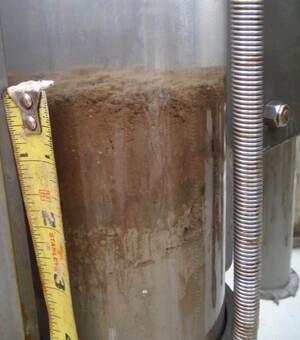
A core sample from the seafloor of the Gulf of Mexico shows a 2-inch layer of oily material. Researchers are finding oil on the seafloor miles away from the blown-out BP well. Though researchers have yet to chemically link the oil deposits to the BP well, "the sheer coverage here is leading us all to come to the conclusion that it has to be sedimented oil from the oil spill because it's all over the place," says one scientist.
Personally, when I spend $10 for a bottle of wine, I don't care if it has a cork cork, a plastic cork, or a screw cap (and frankly, for convenience I prefer the latter two). But an essay at the Guardian suggests that by not using natural cork, I may be endangering the future of cork oak trees.
Deep into one of the 350 remaining cork oak forests (in my case Herdade dos Fidalgos, near Lisbon) sometime between June and August you'll suddenly come across a team of about 20 men, ranging in ages from 16 to 70, striking huge twisted trees with axes. Then, with a sensitivity you would not associate with an axe, they prise the juicy bark from the tree and it is levered from the trunk in great, satisfying pieces. From the base, right up to the beginning of the branches, it is peeled away to reveal the oak's red, nude surface underneath.
When the tree is completely harvested, the axeman takes a swig from his water barrel and moves on to the next. Periodically, a truck comes to collect the pieces of cork and take them to nearby sheds where they will be weathered for months before being processed. The truck is the only obvious exception to a process that hasn't changed since the 18th century, when montados (open cork oak woodlands) and forests here in Portugal, in southern Spain, Morocco, Algeria and Turkey began to be exploited commercially to produce wine corks. A white number is painted on the tree. It will be nine years before it's disturbed again.
This was all new to me; I didn't realize that after the cork was harvested the tree regrew a new supply. The interesting essay goes on to discuss the ecology of cork trees ("Each tree sustains 100 species; it is pretty much the only place in which the rare short-toed eagle and extremely rare Iberian lynx will consider living...") and the recent shift in wine-bottle closure preferences. The problem is that if noone uses cork, economic pressures will tempt owners of the cork forests to shift their "crop" to more lucrative trees:
This story was reported by Popular Mechanics several months ago. The EPA gave their seal of approval to 15 out of 20 bogus products.
To perform this investigation, the Government Accountability Office's (GAO) March 26, 2010, report states that it "used four bogus manufacturing firms and fictitious individuals to apply for Energy Star partnership." All four qualified.
The product was submitted without a standard safety file number from the Underwriters' Laboratories. Plus, the product's website did not include a disclaimer required for Energy Star certification. Last but not least, the garish photo submitted with the product's application portrays what is clearly a feather duster rigged to space heater. Nevertheless, these obstacles proved surmountable—the product was approved in 11 days and became listed on the Energy Star website.
More at the link, including the "gasoline-powered alarm clock"
Detail from Landsat satellite image, Gulf of Mexico, taken on 10/24/99. Individual vessels can be seen as bright spots at end of sediment trails. Other bright spots are fixed oil and gas production platforms. One sediment trail can be traced for 27 km. Credit: SkyTruth
For over two years I've been meaning to write a post decrying the use of "bottom trawling" as a fishing technique. In 2008 I bookmarked an article at LiveScience (via), which included the photo above showing the effects visible from satellite imaging:
Tonight I discovered that the deleterious effects of bottom trawling were first noted (and first protested) in... 1376! This text comes from a petition to King Edward III:
“The commons petition the King, complaining that where in creeks and havens of the sea there used to be plenteous fishing, to the profit of the Kingdom, certain fishermen, for several years past have subtily contrived an instrument called the “wondyrechaun” made in the manner of an oyster dredge, but which is considerably longer, upon which instrument is attached a net so close meshed that no fish, be it ever so small which enters therein can escape, but must stay and be taken.
A litter-cleaning vessel removed floating garbage Tuesday in front of China’s Three Gorges Dam before opening the dam’s gates to lower the water level in the reservoir, swollen by recent flooding in the region. (ZUMApress.com)