Showing posts with label nature. Show all posts

The River Thames - then and now

Excerpts from an article at The Telegraph about the return of wildlife to a newly-cleaned-up Thames:
It was near this spot in 1878 that more than 600 passengers on the steamship Princess Alice died when the pleasure boat sank in a collision. As they swam towards the safety of the shore, the passengers were overcome by the noxious cocktail of pollution in the water. In 1957, the pollution levels became so bad that the River Thames was declared biologically dead. The amount of oxygen in the water fell so low that no life could survive and the mud reeked of rotten eggs.

Fifty years later, the Thames has become a very different place. It teems with life: 125 species of fish swim beneath its surface while more than 400 species of invertebrates live in the mud, water and river banks. Waterfowl, waders and sea birds feed off the rich pickings in the water while seals, dolphins and even otters are regularly spotted between the river banks where it meanders through London...

Environmental officials now say the Thames is the cleanest it has been in more than 150 years and nearly 400 habitats have now been created to allow wildlife back into the river...

Much of the return of wildlife to the Thames has been due to improvements in water quality. Strict legislation now prevents industry from dumping polluted effluent into the river and its tributeries. Sewage from London and the surrounding area is now treated and then exported.

“Improving the water quality is only half of the battle though,” explains Antonia Scarr, a senior marine advisor with the Environment Agency. “We have had to create the habitats to allow the plants, fish and wildlife to move into...

Even on the smaller rivers and streams that feed into the Thames there is a transformation underway. In Greenwich and Lewisham, extensive work is underway to re-naturalise rivers that for decades have passed unnoticed beneath residents feet... The river Quaggy in Greenwich is one such example. In an area called Sutcliffe Park, the river passed though a culvert hidden beneath a large flat area that was used for football pitches. But in an attempt to restore the wildlife and rich biodiversity that once lived on the river, the Environment Agency opened up the culvert allowed the river to meander through the park.
More at the link. The painting is entitled The Thames by James Jacques Joseph Tissot (1876), via The Mariner's Revenge Song.

p.s. - I've entitled this post "The River Thames..." because I've seen the words used in that order in quite a few different places.  I think I've seen "The River Nile" (perhaps without uppercase r?), but never "The River Mississippi" or "The River Yukon."  Does anyone know what governs a convention like this?

"Apple feeder" for birds

Constructed out of a coathanger and pieces of bamboo, as explained in the comments at Peregrine's Bird Blog.  I'll have to try this, especially since rotting fruit also attracts a variety of butterflies.

"Here, let me get that for you..."

Presumably the blackbirds at this location are picking ticks, fulfilling the role of oxpeckers.

Photo posted at Pixdaus by Hammerchewer.

Prize-winning photomicrography

Living Licmophora juergensii on red alga, together with the diatom Cocconeis and filamentous cyanobacterial colonies. Licmophora cells can move to locate a place with suitable light exposure. They then produce a mucilaginous stalk for fixation on the substratum. Multi-layer image captured using differential interference contrast. Sample collected from Bodden, the brackish waters lying between the isles of Hiddensee and Rugia (German Baltic Sea).
This image comes from the Olympus BioScapes 2010 Winners Gallery.  Dozens of other fantastic photographs at the link.

Photographer: Wolfgang Bettighofer, Kiel, Germany.  Via MSN.

Were pygmy mammoths present in ancient Egypt?

Excerpts from an interesting piece at Tetrapod Zoology -
...here's the image, as it appears on the beautifully decorated tomb wall of Rekhmire, 'Governor of the Town' of Thebes, and vizier of Egypt during the reigns of Tuthmose III and Amenhotep II (c. 1479 to 1401 BCE) during the XVIII dynasty...

... drew attention to the small, tusked, hairy elephant in the painting, shown as being waist-high to the accompanying people... Its apparent hairiness, convex back and domed head make it look like a juvenile Asian elephant, but then why it is shown with huge tusks?

Inspired by the then-new discovery that a dwarfed population of Woolly mammoths Mammuthus primigenius were still living as recently as 3700 years ago (albeit on Wrangel Island in the Siberian Arctic: Vartanyan et al. (1993), Guthrie (2004)), Rosen (1994) made the tentative suggestion that the elephant shown in Rekhmire's tomb might actually be a dwarf Woolly mammoth. If true, this would have radical implications. It would mean that the ancient Egyptians had a trading link of sorts with far eastern Siberia, and also that mammoths were captured and then transported alive to Africa!..

... there is then a third possibility: this being that Rekhmire's elephant is neither a Siberian mammoth nor a wrongly-scaled 'symbolic' elephant, but perhaps a depiction of one of the pygmy Mediterranean island-dwelling species. Most of the dwarf Mediterranean elephants were Pleistocene animals that were long gone by the time of the Pharoahs, but Masseti (2001) noted that a population of dwarfed elephants seem to have lingered on in isolation on the Greek island of Tilos (located between Rhodes and Kos)...
More at the link, via BoingBoing.

Weaver bird nests

Sociable weaver (Philetairus socius) nest in a quiver tree (Aloe dichotoma), Fish River Canyon, Namibia. Sociable weavers construct the largest nests of any bird, housing hundreds of individuals spanning many generations.
Very impressive!  Credit here, via Electric Orchids.

Saffron

An article (and video) at Russia Today details some of the problems faced by saffron farmers in Kashmir, including damage to traditional fields from pollution.
Costing US$4,000 per kilogram, this pricey ingredient is used in medicine and South Asian cuisine... The biggest long-term challenge is the adulteration of saffron. Cheap, fake brands of saffron sell briskly on the streets of Srinagar. And it is virtually impossible for a non-professional to distinguish between a fake and the real one. This fact has dented saffron's image, and resulted in a drop in prices.
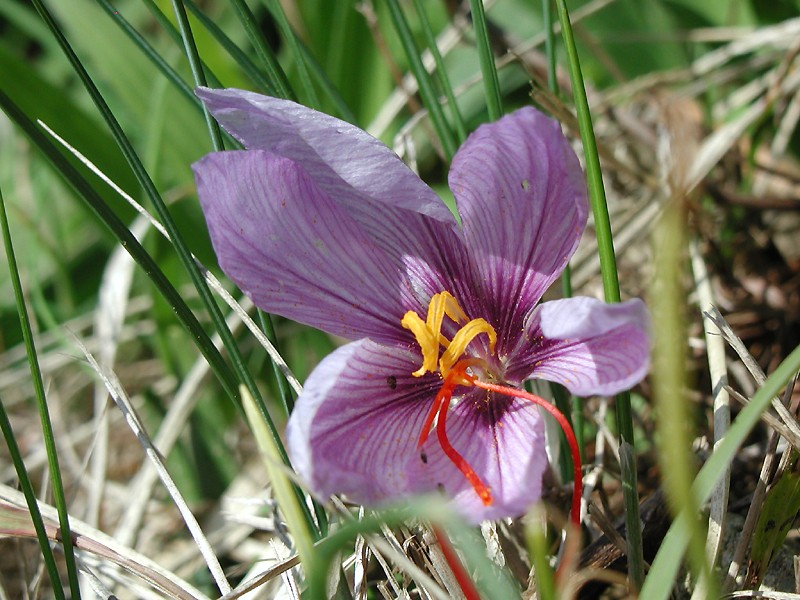
The word "saffron" (and Italian zafferano and Spanish azafrán) come from the Latin word safranum, probably ultimately from Persian and Arabic precursors.  The spice itself is extracted from the saffron crocus (C. sativus).  [The photo above is of non-saffron Wisconsin crocuses].  The following tidbits are excerpted from Wikipedia:
Saffron-based pigments have been found in 50,000 year-old depictions of prehistoric places in northwest Iran. Later, the Sumerians used wild-growing saffron in their remedies and magical potions. Saffron was an article of long-distance trade before the Minoan palace culture's 2nd millennium BC peak... During his Asian campaigns, Alexander the Great used Persian saffron in his infusions, rice, and baths as a curative for battle wounds. Alexander's troops imitated the practice from the Persians and brought saffron-bathing to Greece...

During the 14th century Black Death, demand for saffron-based medicine skyrocketed, and much saffron had to be imported via Venetian and Genoan ships from southern and Mediterranean lands... Cultivation and trade then spread to Nuremberg... Soon after, saffron cultivation spread throughout England, especially Norfolk and Suffolk... By 1730, the Pennsylvania Dutch were cultivating saffron throughout eastern Pennsylvania. Spanish colonies in the Caribbean bought large amounts of this new American saffron, and high demand ensured that saffron's list price on the Philadelphia commodities exchange was set equal to that of gold...

Saffron is widely used in Iranian (Persian), Arab, Central Asian, European, Pakistani, Indian, Turkish, and Cornish cuisines. Confectionaries and liquors also often include saffron. Common saffron substitutes include safflower, annatto, and turmeric...

A pound (454 grams) of dry saffron requires 50,000–75,000 flowers, the equivalent of a football field's area of cultivation... Forty hours of labour are needed to pick 150,000 flowers... The price in Canada recently rose to CAN$18,000 per kilogram. In Western countries, the average retail price is $1,000/£500/€700 per pound (US$2,200/£1,100/€1,550 per kilogram)...

Saffron is graded via laboratory measurement of crocin (colour), picrocrocin (taste), and safranal (fragrance) content. Determination of non-stigma content ("floral waste content") and other extraneous matter such as inorganic material ("ash") are also key... Adulteration was first documented in Europe's Middle Ages, when those found selling adulterated saffron were executed under the Safranschou code. Typical methods include mixing in extraneous substances like beets, pomegranate fibers, red-dyed silk fibers, or the saffron crocus's tasteless and odorless yellow stamens. Other methods included dousing saffron fibers with viscid substances like honey or vegetable oil. However, powdered saffron is more prone to adulteration, with turmeric, paprika, and other powders used as diluting fillers. Adulteration can also consist of selling mislabeled mixes of different saffron grades. Thus, in India, high-grade Kashmiri saffron is often sold and mixed with cheaper Iranian imports; these mixes are then marketed as pure Kashmiri saffron, a development that has cost Kashmiri growers much of their income...
Here's a photo a real saffron crocus (note the red "thread").

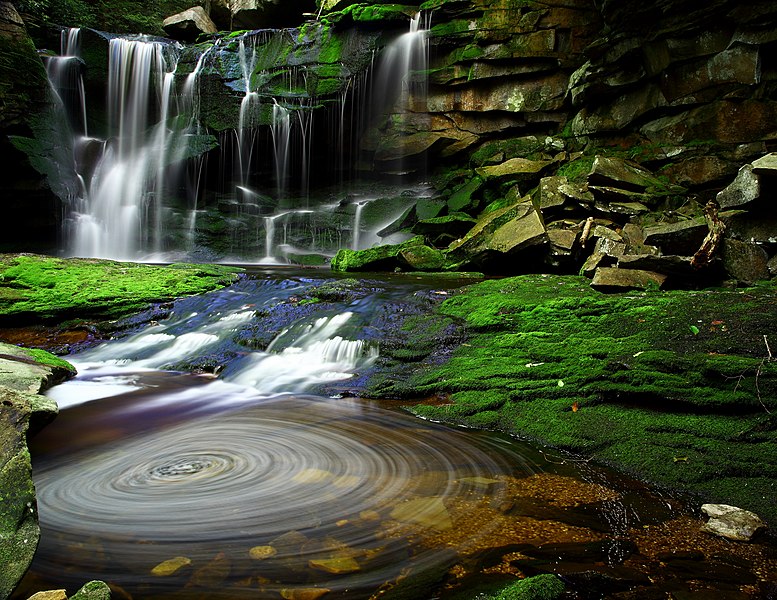
Elakala Waterfalls, West Virginia

Nice use of a small aperture/long exposure to transform the motion of the little whirlpool.  This photo was one of three "Pictures of the Year" in Wikipedia Commons for 2009.  The other two photos (and winners in previous years) can be seen here.

Mastodon tusks

From the Carpenter Collection at the Library of Congress.  I couldn't locate any text related to the photos, but they have been filed in the "Alaska" category.

Via First Time User.

"Sudden oak death"

The phrase refers to a disease caused by Phytophthora ramoru, a fungus that affects oaks and other plants.  The Guardian had an article today about the devastation occurring in parts of the U.K. -
In woodlands around the UK, just as here in Afan Valley, south Wales, the race is on to fell thousands of trees in a desperate effort to contain a new disease which poses a threat to British forests on a scale not seen since Dutch elm disease wiped out millions of trees, changing the landscape of the country for ever.

Already 3,000 hectares of larch forest – one hectare is about the size of a football pitch – in Wales, Devon, Cornwall, Somerset and Northern Ireland are known to be infected by Phytophthora ramorum – sudden oak death – which comes from the same family as the potato blight organism that caused the Irish famines in the 19th century...

In 2003, it turned up in a handful of oaks, but they seemed to have resistance and the outbreak did not seem to be too worrying. Then last year, taking everyone by surprise, the phytophthora jumped species and rapidly began infecting and killing the commercially important Japanese and European larch trees. It has also been found in several conifer species, including Douglas fir...

"I think we can forget eradicating it; we have to work with nature and we're going to have to live with it. The question is whether or not we're lucky and have a fighting chance at containing it," he added. "Unfortunately we are very fond of exotic plants from other parts of the world, and that leaves the door wide open to risk."..
The disease may have arrived in the U.K. from the U.S., where it has been present for years.  This map shows areas in this country at risk for the disease:
Those interested (or potentially affected) can read more at Wikipedia, and at this resource page for the Northeast Plant Diagnostic Network.

Wasp nest

We have an old wasp nest stored at our house (and there's one in the woods not far from here that's as big as a beachball, but too high for me to retrieve).  Ours is a rather homogeneous gray, quite a log power less impressive than this one from HarryR's Flickr photostream, found in an attic in the U.K.  His wasps must have had access to a nice variety of pulp materials.

Bats in blankets

Victims of the flooding in Queensland:
Australian Bat Clinic and Wildlife Trauma Centre director Trish Wimberley and her carers have helped save 130 orphaned bats on the Gold Coast in past weeks... Carers have visited several bat 'camps' on the coast in recent weeks to find four-week-old babies on the ground covered in maggots and fly eggs. Trish said: "They're coming down to feed on the ground. That makes them vulnerable... The surviving youngsters will be bottle fed and kept either hanging on clothes lines or in special intensive care units until they are ready to fly again in about four weeks.

"Winterkill" explained

From a report in yesterday's StarTribune:
Those big December snowfalls have crews on some Minnesota lakes heading onto the ice earlier than usual this winter in an effort to prevent mass fish kills.  They're on a rescue mission to install aerators and create open water before oxygen levels plummet to the point that fish essentially suffocate under the ice. Some lakes are already showing faster-than-usual oxygen depletion...

Winterkill is a natural process that happens when fish don't have enough dissolved oxygen in water, he said. Because of the ice cover, oxygen in winter comes mainly from aquatic plants, which receive enough sunlight through ice to grow.  But in years with lots of snow, sunlight penetrates ice less and plants stop growing. Instead of producing oxygen in water, the plants consume it as they die and decompose...

Sometimes it kills all the fish in a lake, he said, and sometimes it only affects part of a lake or some species of fish. It is more of an issue in southern Minnesota, he said, where more lakes tend to be shallower.  Trout require the most oxygen, followed by bluegill and largemouth bass, according to fisheries managers.  Walleye, northern pike, carp and crappies can tolerate less oxygen, and bullheads and fathead minnows need the least amount of oxygen to survive...

The DNR grants about 300 permits for cities, lake associations, park districts and even some sportsmen's clubs to install and maintain aerators on lakes. The purpose is to keep open water during winter so fish will have a fresh source of oxygen...

Bagworms

Excerpts from a nice post at Naturespeak:
Bagworm sacs are spindle-shaped bags constructed of silk and plastered with dead spruce needles (although they are known to eat just about any plant – over 100 food plants – they prefer evergreens). Each structure is secured to the branch with a silken tie and, depending on whether they were made by a male or female worm, are either empty or full of eggs...

Eventually they emerge as adults in the early fall. The males, wasp-like creatures with clear wings, push their way out of the bag and fly off to seek the company of the females. The females, however, are wingless and are forced to remain within the confines of their bag. When the males find the females they mate with them through the narrow opening at the small end...

The impregnated females lay their egg clusters within the bag before crawling out and dropping helplessly to the ground. She will lay upwards of 1,000 eggs. Both sexes die shortly after mating (although the males are able to visit with a few more bags before cashing it in!) All this means that by wintertime only the female bags will contain living material in the form of yellowish egg clusters. The male shelters will be completely empty or contain the empty pupal skins...
I have seen these on our pine trees and just viewed them as decorated/camouflaged pupae; never knew the interesting backstory. You learn something every day.

Deep snow. Really deep snow. Now with video.

 The location depicted is in the Japanese Alps:
The section of the Tateyama Kurobe Alpine Route linking the Tateyama station and Ogizawa only open from mid April to November, the reason for this hiatus is wintry snow, snow on this section reaches a thickness of 20 meters the most amazed of all is that in mid-April, much of the snow still lingers, so you have to make real corridors of ice to get through that stretch.
For those wondering (like me) how the snow is cleared from this road, this video shows the equipment needed.

Posted for Richard and Dottsie, who got the brunt of the 30" snowfall that hit northern New Jersey this week.

Text credit Genjutsu.  Photo via Gizmodo.

Addendum:  A hat tip to Karl, who found at Vimeo a video taken while driving through the "snow corridor."  I had no idea it was so long.  But what startled me was that where there are no pull-off lanes, drivers just stop and park their cars in the road. (!)

Shrimp

Limbs virtually transparent except for that remarkable purple vasculature.  Tagged "Indonesia," credit to "Nartshuk Andrew," found at Pixdaus.

Trillium

Photographed at Honey Creek State Natural Area, May 2008.  Posted for Andrew and others who miss the old header photo.  Click for slightly larger version.

Solanum mammosum

Explained at Kuriositas.

The contents of an "owl pellet"

I sometimes see these while hiking.  A post this week at Naturespeak reminds me that I need to take the time to dissect one sometime. 

For those who don't go out walking, or live in urban areas, owl pellets are available for purchase at sites that provide educational materials.  They make interesting gifts for children with inquisitive minds.  (I should have mentioned this before Christmas...)

The contents of a "wunderkammer"

I've lost my links leading up to this set of seven photos, so I'm not even sure to whom this "cabinet of curiosities" belonged.  Embedded above:  his/her collection of corals, insects, and critters in alcohol.