Showing posts with label religion. Show all posts

How should you address God?

An article at the BBC this morning discusses the impact the King James Bible has had upon the English language, enumerating the number of phrases that have come into our language from that source (257 to be exact, according to one scholar), and the number of new words (about 40 - much fewer than the thousand or so introduced by Edward deVere).

What I found most interesting in the piece was this bit about forms of address used when speaking to God:
Has the KJB kept Christian language stuck in the 17th Century? "We thank thee, O God, for the manifest blessings that thou hast vouchsafed unto us," is one example of such a passage.

"It's the last thing the translators would have wanted," argues Simon Jenkins, editor of the Christian website shipoffools.com. "Ironically, at the time, 'you' was a more formal way of addressing someone, and 'thou' was more familiar, but they decided not to use any special grammar for God. He was 'thou' just like everybody else.

"But when I was being brought up, people were still talking to God as 'thou''. it's hopelessly antiquated and alienating. The translators made the right decision at the time, but what the church later did with it doesn't convey that intention at all."
More at the BBC.

Cynocephaly in portrayals of Saint Christopher

Dog-headed gods were a well-known component of the Egyptian pantheon.  Some Greeks believed that dog-headed people lived in distant lands, and ancient maps sometimes display such creatures in unexplored regions.

But the Christian Saint Christopher is also depicted in this fashion.
Today the legend of St Christopher helping Christ cross the river has obscured the important canine detail: though the river fording is almost certainly a late addition. In the early Middle Ages the most famous thing about St Christopher was his dog’s head. Indeed, good St Chris is often portrayed thus in medieval manuscript and sculpture...

One possible explanation is that Christopher was the Egyptian god Anubis in disguise. This explanationm suffers from a fatal flaw, however: the two have absolutely nothing in common bar their dog head and some associations – vague in the case of Christopher - with Egypt.

The answer is, instead, almost certainly to be found in an early misunderstanding of some of the grains of fact in the Christopher legend... It appears that Christopher served the Empire in the Cohors III Valeria Marmaritarum. If the name of this unit is to be taken at face value then these soldiers were Marmaritae a tribal people dwelling to the south-west of Egypt, outside the Imperial borders...

But what is interesting is that the first surviving description of this corner of the world, in Herodotus no less, tells us that it was here that the dogheads lived. Early on in the tradition of St Christopher an author perhaps innocently made the connection that was then afterwards taken seriously by hagiological duffers...
From Beachcombing's Bizarre History Blog, where there are additional details.

"Feed the Flock" Pepsi ad pulled from Super Bowl consideration


This ad was pulled from consideration for use by Pepsi during the Super Bowl because it was deemed to be "irredeemably offensive" to Christians.  A representative from Pepsico has apologized to the public for having the ad even in consideration.

It has been pulled from their website and reportedly also from YouTube.  So this embed may not last long.   Warning:  This advertisement this might offend your religious sensibilities (or just your sense of good taste).

Via Althouse (another Madison blogger). 

Update: As predicted, the video has been yanked from YouTube.  It is, however, now available at this link.  At least for a while...

Tides remain a mystery to some people

Bill O'Reilly interviews an outspoken atheist regarding the latter's organization's claim that religion is a scam.  The following exchange ensues:
O’Reilly: I’ll tell you why [religion's] not a scam. In my opinion, all right? Tide goes in, tide goes out. Never a miscommunication. You can’t explain that. You can't explain why the tide goes in...

Silverman: Tide goes in, tide goes out...?

O’Reilly: Yeah, see, the water — the tide comes in and it goes out, Mr. Silverman. It always goes in...

Silverman: Maybe it’s Thor up on Mount Olympus who’s making the tides go in and out...

O’Reilly: No no, but you can’t explain that... you can’t explain it...
The full interview is posted at YouTube; I listened only long enought to confirm that the extract above was not taken out of context, but couldn't listen to the whole thing because I find both people annoying.

Via Daily Kos.

An unusual cemetery in northern Iran

Three shrines and hundreds of tombstones left by an unknown people -
The cemetery lays in the northern part of Golestan province, in the mountains of Torkaman Sahra (Turkmen Desert) near the border with Turkmenistan... The holy place encompasses actually not one but three shrines, revered by local tradition as the tombs of the prophet Khaled Baba, his father-in-law Alaam Baba and his shepherd Chupan Ata...

Prophet Khaled himself is claimed in the legend hanging on the wall of the sanctuary to have been born in Yemen, his father was called Sanan, and he died here in 528, that is 42 years before the birth of Mohamed and 82 years before the beginning of Mohamed’s prophetic mission. The obvious question concerning the faith of which he was a prophet eighty-two years before the very foundation of Islam, is not raised in the legend. However, it is very probable that he was a Nestorian Christian, one of those who in this period migrated in a growing number to the north-eastern regions of the Persian empire, and from there further to China along the Silk Road...

In the cemetery laying a few hundred meters from the shrines around six hundred tombstones have been preserved. The stones are basically two kinds: either long columns ending in round hats which are sometimes two meters high or more, or smaller, squat grave posts similar to a cross where the two arms of the cross are replaced by two semi-circles or almost complete circles...

...if we project these places on the map, we see that almost all of them lay north of the majestic Gorgan Wall, built several centuries before Christ which, stretching from the Caspian Sea to the Afghan mountains, defended Iran from the attack of the northern tribes (and which was first excavated by the Hungarian Aurel Stein in 1915). Perhaps these cemeteries belonged to such tribes of the steppe, which would also give an explanation for the lack of any settlement around them.
If this interests you, there is more information and about three dozen more photos at Poemas del rio Wang.  I'm also intrigued by the reference to the Great Wall of Gorgan, the second longest in the world.  I have walked on the Great Wall of China and Hadrian's Wall and visited the Berlin Wall, but have never even heard of this one.  You learn something every day.

The "Ground Zero Mosque" as manufactured news

The graph above shows references to the Ground Zero Mosque as compiled by Google News' timeline.  Here is some analysis from a column at Salon:
It evolved into the national political obsession of the summer and, finally, into a midterm election issue. And then, just like that, it disappeared...

News of the proposed Islamic community center first broke in a front-page New York Times piece in December 2009, but it garnered very little attention. The attention it did receive -- including from the likes of Fox News -- was positive...

The first peak in the coverage came when a wave of national Republican figures weighed in. Rudy Giuliani, Newt Gingrich and Tim Pawlenty each took shots at the project and its organizers...

The second peak in coverage came in mid-August when President Obama weighed in at a press conference, citing religious freedom. Those comments gave political reporters an excuse to keep writing about the story for weeks.

But then, after a last gasp in October in the run-up to the election (including a few memorable anti-mosque campaign ads), the story all but disappeared. What changed? Well, on the ground, exactly nothing. The organizers had not changed their plans. Fundraising continued.

There can be no single explanation for why a news story of this magnitude disappears. But, given the timeline here, it seems likely that the electoral calendar played a role. National Republicans who used Park51 as a bludgeon against Democrats suddenly were less interested in talking about the project after the election...

Looking back now, it's pretty good evidence of a manufactured story when coverage spikes and then vanishes, even as nothing has fundamentally changed.
More at the link.

An unexpected copyrighted book

The Telegraph has a New Year Literary Quiz.  I won't duplicate it here; those interested can take the quiz (and view the answers) at the link.  But I will blog this most curious item:

Question:   Which 1611 book is still not out of copyright in Britain — because the rights are held in perpetuity by the British Crown?

Answer:  The King James Bible (or Authorised Version)

?? !!!

Illuminated Gospel

Royal Collection curator Deborah Clarke held the Lorsch Gospels, which went on display Tuesday, with gloved hands. Pope Benedict gave the manuscript to Queen Elizabeth during a recent visit to the United Kingdom. (PA Photos/Landov)
Via the WSJ.

What was Jesus' last name?

Something I'd never thought of, until I read this column at Slate:
Many people shared the name. Christ's given name, commonly Romanized as Yeshua, was quite common in first-century Galilee. (Jesus comes from the transliteration of Yeshua into Greek and then English.) Archaeologists have unearthed the tombs of 71 Yeshuas from the period of Jesus' death. The name also appears 30 times in the Old Testament in reference to four separate characters...

So why do we call the Hebrew hero of Jericho Joshua and the Christian Messiah Jesus? Because the New Testament was originally written in Greek, not Hebrew or Aramaic. Greeks did not use the sound sh, so the evangelists substituted an S sound. Then, to make it a masculine name, they added another S sound at the end. The earliest written version of the name Jesus is Romanized today as Iesous. (Thus the crucifix inscription INRI: "Iesus Nazarenus Rex Iudaeorum," or "Jesus of Nazareth, King of the Jews.")...

In contrast, the Old Testament was translated directly from the original Hebrew into English, rather than via Greek. So anyone named Yehoshua or Yeshua in the Old Testament became Joshua in English...

What was Jesus' last name? It wasn't Christ. Contemporaries would have called him Yeshua Bar Yehosef or Yeshua Nasraya. (That's "Jesus, son of Joseph" or "Jesus of Nazareth.") Galileans distinguished themselves from others with the same first name by adding either "son of" and their father's name, or their birthplace. People who knew Jesus would not have called him Christ, which is the translation of a Greek word meaning "anointed one."
More at the Slate link.

Muslim students find acceptance at Catholic colleges

Excerpts from an article in the Washington Post:
In the past few years, enrollment of Muslim students such as Shabnan has spiked at Catholic campuses across the country. Last year, Catholic colleges had an even higher percentage of Muslim students than the average four-year institution in the United States, according to the Higher Education Research Institute. The influx has astonished and sometimes befuddled administrators. Some Catholic campuses are creating prayer rooms for new Muslim students and hiring Islamic chaplains to minister to them. Others are unsure how to adapt...

Muslim students say they enroll at Catholic schools for many of the same reasons as their classmates: attractive campuses, appealing professors and academic programs that fit their interests. But there is also a spiritual attraction to the values that overlap the two faiths.

"Because it is an overtly religious place, it's not strange or weird to care about your religion here, to pray and make God a priority," said Shabnan, a political science major who often covers her head with a pale beige scarf. "They have the same values we do."

Georgetown University, whose Muslim student numbers have also been climbing, has a prayer room, student association and an entire center devoted to Muslim-Christian understanding, and the school hired a full-time Muslim chaplain in 1999. Catholic administrators at colleges that have added similar features say they haven't perceived the efforts as a challenge to their religious identity.

"We're not going to take down the cross or change our name. We're proud of who we are," said Marco Masini, associate vice president of student life at Benedictine University in Illinois. "Hospitality is a part of the Benedictine philosophy, so it's important we welcome individuals of all faiths."

Basiri said his Islamic faith has grown and matured in the past four years while studying in buildings named after Catholic leaders, in classrooms adorned with crucifixes, and with classmates often named after saints.

"The face of my prophet and my God has changed," he said. "It is even more beautiful now."
More at the link.

A Qur'an "etched in Saddam Hussein's blood"

Over the course of two painstaking years in the late 1990s, Saddam Hussein had sat regularly with a nurse and an Islamic calligrapher; the former drawing 27 litres of his blood and the latter using it as a macabre ink to transcribe a Qur'an. But since the fall of Baghdad, almost eight years ago, it has stayed largely out of sight - locked away behind three vaulted doors.
The very existence of this item is creating some ethical dilemmas for Iraqi authorities, discussed at the Guardian link.
"It was wrong to do what he did, to write it in blood," says Sheikh Samarrai. "It is haraam [forbidden]."

Sudanese woman publicly flogged


Some version of the disturbing clip, which seems to have been filmed with the knowledge of the officers, were reportedly removed from YouTube, but dozens of copies remain on the video-sharing site. One copy, which has been viewed nearly half a million times, was edited to add English subtitles, and some music. (Warning: the images in the video are graphic and may upset many viewers.)

As the [Reuters] explained, “Floggings carried out under Islamic law are almost a daily punishment in Sudan for crimes ranging from drinking alcohol to adultery. But vague laws on women’s dress and behavior are implemented inconsistently.”
Via The Lede at the NYT.

Bumper stickers

This photo was originally labeled "Hatred."  I agree with the comments at Reddit that...
Ignorance leads to fear, and...
"Fear leads to anger.
Anger leads to hate.
Hate leads to suffering."*
*(Yoda, The Phantom Menace)
Photo source. 

Harry Potter toys and the Salvation Army

CALGARY — The Salvation Army says it refuses to distribute Harry Potter and Twilight toys collected for needy children because they’re incompatible with the charity’s Christian beliefs...

...he was told by Salvation Army officials that the two kinds of toys are “disposed of” and not given to other charities....

“I was told to withhold a six-inch Harry Potter figure, but when I picked up a plastic M-16, I was told, ‘That’s for the 10-year-olds,’” he said.
Via Cynical-C.

Update Dec 15: Reader Glenn Whidden found evidence that the incident cited above may have been the policy of only one Salvation Army group in Canada, and that the Salvation Army as a whole does not have a policy against Harry Potter toys.  Story here.

"I praise you 24/7!!!!!! And this is how you do me!!!!!"


Buffalo Bills' wide receiver Stevie Johnson dropped five passes in the team's loss to the Steelers including a potential game-winner (see above), then after the game Tweeted this message:
Found at 22 words, where there are a variety of relevant comments...

Hajj

Click for bigger.  Two selections from a set of 34 images at Boston.com's The Big Picture.


Photo credits: MUSTAFA OZER/AFP/Getty Images (top) and AP Photo/Hassan Ammar (lower).

St. Eulalia (1885)

Intrigued by the image on this painting by John William Waterhouse, RA (1849-1917), I had to look up the backstory. 
Eulalia was a devout Christian virgin, aged 12–14, whose mother sequestered her in the countryside in AD 304 because all citizens were required to avow faith in the Roman gods. Eulalia ran away to the law court of the governor Dacian at Emerita, professed herself a Christian, insulted the pagan gods and emperor Maximian, and challenged the authorities to martyr her...

She was then stripped by the soldiers, tortured with hooks and torches, and burnt at the stake, suffocating from smoke inhalation. She taunted her torturers all the while,[4] and as she expired a dove flew out of her mouth. This frightened away the soldiers and allowed a miraculous snow to cover her nakedness, its whiteness indicating her sainthood.
Image via La Muse Verte.

Jonah/Yunus meets the "big fish"

Jonah in the fish’s mouth by Giotto and workshop
Like many important Biblical characters, Jonah is also important in Islam as a prophet who is faithful to God (Allah) and delivers His messages. He is known to Muslims by his Arabic name, Yunus "Arabic: يونس", and also as (The One with the Whale "Arabic: ذو النون"). Sura 37 (equivalent to chapter 37) of the Qur'an is where the full story of Prophet Jonah is recounted...
Via Miss Folly.

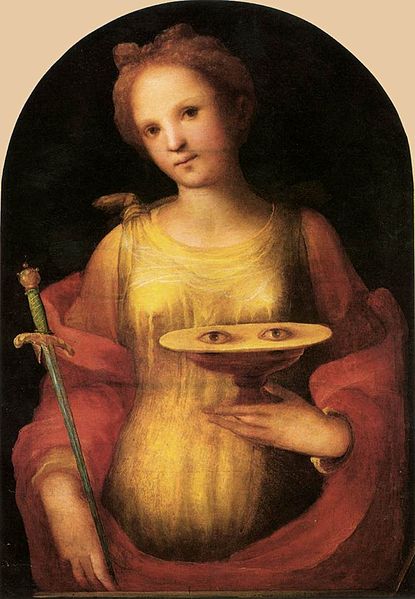
The eyes of St. Lucy

Saint Lucy, by Domenico Beccafumi, 1521, 
a High Renaissance recasting of a Gothic iconic image (Pinacoteca Nazionale, Siena)
Saint Lucy, also known as Saint Lucia (283 – 304), was a wealthy young Christian martyr who is venerated as a saint by Roman Catholic, Anglican, Lutheran, and Orthodox Christians. Her feast day in the West is 13 December, by the unreformed Julian calendar the longest night of the year; with a name derived from lux, lucis "light", she is the patron saint of those who are blind. Saint Lucy is one of the very few saints celebrated by members of the Lutheran Church among the Scandinavian peoples, who take part in Saint Lucy's Day celebrations that retain many elements of Germanic paganism...  She consecrated her virginity to God,  refused to marry a pagan, and had her dowry distributed to the poor. Her would-be husband denounced her as a Christian to the governor of Syracuse, Sicily. Miraculously unable to move her or burn her, the guards took out her eyes with a fork...

Jacobus de Voragine did not include the episode of Lucy's passion that has been most vivid to her devotés ever since the Middle Ages: having her eyes torn out. It should be noted that another account dates this loss of eyes to before her martyrdom, claiming that in response to a suitor who admired her beautiful eyes, "she cut them out and sent them to him, asking to be left in peace thereafter." Lucy was represented in Gothic art holding a dish with two eyes on it. The legend concludes with God restoring Lucy's eyes...

In Mark Musa's translation of Dante's Purgatorio, it is noted that Lucy was admired by an undesirable suitor for her beautiful eyes. To stay chaste she plucked out her own eyes, a great sacrifice for which God gave her a pair of even more beautiful eyes.

Hobbes defines "heaven"


Found at La Muse Verte, and posted for cousin Karl in Barcelona.